
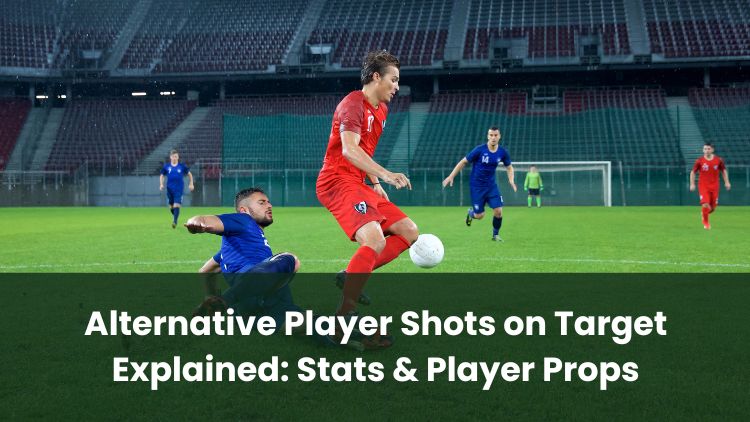
Understanding player shots on target is increasingly important for anyone interested in football statistics and related markets. Alongside standard player props, alternative player shot lines add another layer of detail that can reward careful analysis.
This blog post explains how alternative shot lines differ from traditional options, how traders set them, and which statistics matter most. It also covers match context, team tactics, and how to interpret what you see on the screen.
To round things off, it highlights reliable data sources and clears up common misconceptions so the topic feels practical rather than technical, whether you are experienced or just getting started.
What Are Alternative Player Shots On Target Markets?
Alternative player shots on target markets offer more specific and customisable lines than the usual options. Rather than a single over or under line, these markets present several totals, such as 0.5, 1, 2, 3 or higher, each with its own price.
This flexibility means you are not restricted to the main line. If the standard market lists a player to have at least one shot on target, the alternative menu might include options for two, three, or more. These are often available for major fixtures or prominent players, though coverage varies by match.
Because the lines are more granular, they suit those who like to focus on particular outcomes that match their research. That naturally leads to a key question: how do they differ from standard props?
How Do Alternative Lines Differ From Standard Player Props?
Standard player props usually offer a single decision, such as a player to have over or under a specific number of shots on target, typically with only one or two choices per player.
Alternative lines expand that choice with multiple totals, for example 0.5, 1.5, 2.5 or higher, each reflecting a different level of difficulty. Prices move with perceived likelihood, so the higher the total, generally the bigger the return if it lands.
In short, alternative lines increase precision and control. Knowing that, it helps to understand how trading teams decide where to set those numbers in the first place.
How Are Lines For Player Shots On Target Set?
Trading teams set shots on target lines using a blend of data, modelling, and expert judgement. Core inputs include a player’s recent form, average shots on target, and the quality and style of the opposition. Player role and expected minutes matter too, as do injuries, suspensions, and likely substitutions.
Historical data is used to spot patterns, such as how a forward performs against compact defences or whether an attacking midfielder’s output rises when partnered with a certain striker. For alternative markets, several lines are posted to reflect different performance levels, with each line priced according to the projected probability.
With the scaffolding in place, the next step is to focus on the player metrics that tend to drive those projections.
Key Player Statistics That Predict Shots On Target
A handful of statistics consistently help estimate a player’s shots on target in a single match. Used together, they give a clearer picture than any one number on its own.
Expected Shots On Target And Shot Quality
Expected Shots on Target (xSoT) blends shot frequency with the likelihood that an attempt will be accurate. It accounts for where the effort is taken and the situation at the time. Attempts from the central channel or inside the box typically carry a higher chance of testing the goalkeeper than speculative efforts from distance or tight angles.
Shot Volume, Shot Locations And SOT Percentage
Shot volume tracks how often a player shoots over time, for example per 90 minutes. Consistent shooters naturally have more opportunities to register on target.
Shot location provides crucial context. Efforts from inside the penalty area tend to be more accurate than long-range attempts, and touches in central areas often precede higher-quality shots.
Shots on Target percentage shows the share of a player’s total shots that are on target. If a player takes 40 shots in a season and 16 are on target, the percentage is 40%. A strong rate can indicate reliable technique or smarter shot selection, but it is best interpreted alongside volume and locations.
Armed with these metrics, the next question is how to apply them when you see a specific player line on the screen.
How To Read And Interpret Player Shots On Target Props
Shots on target props are typically displayed as a player’s name with a total and a price, for example Over 1.5. That price reflects the bookmaker’s view of how often the outcome will occur and shapes the potential return.
Context gives the numbers meaning. A forward averaging 1.2 shots on target per 90 against mid-table sides might be posted at 0.5 or 1.5 depending on the opponent’s defensive record, expected team shape, and whether the player is likely to complete the full match. Role changes can also matter: a winger moved into a central role often sees a different output profile.
It is also worth knowing what qualifies as a shot on target under the operator’s rules. Typically, only efforts that result in a goal or require a save from the goalkeeper are counted. Deflected shots that are going wide, and attempts blocked by defenders before reaching the goal, usually do not count. Operator definitions can vary, so checking the market rules avoids confusion.
There is more than one way these props are packaged, and the menu can be broader than a single player total.
Market Variations And Betting Options For Player Shots On Target
The most common market is the individual player total, where the outcome hinges on a set number of shots on target. Some operators also list “exact” totals, such as exactly two, which narrow the outcome to a single result.
Beyond that, there are combinations and specials. Combined lines might require two named players each to register at least one shot on target, or they might total the output of a strike partnership. Scenario-based markets also appear, such as first shot on target or a player to have a shot on target in each half, which appeal when analysing specific match-ups or game states.
All of which ties back to how teams set up and how the match is likely to unfold.
How Do Team Tactics And Match Context Affect Player Shots On Target?
Team approach is a major driver. Sides that press high and sustain attacks tend to produce more shooting opportunities for central forwards and late-arriving midfielders. Conversely, a conservative setup can limit volume and push attempts to lower-quality areas, such as from the touchline or long range.
Individual roles matter just as much. A striker who drifts wide to create space for a runner from midfield may see fewer central shots, while an inverted winger encouraged to cut inside can see attempts rise from the half-spaces. Set-piece duties can also add occasional on-target efforts for centre-backs in certain fixtures.
Match context often shifts output. Facing a deep, organised defence can suppress central shots, while chasing a game late on can inflate volume through sustained pressure. Weather, pitch conditions and rotation affect execution and minutes, which in turn affect totals.
Good data helps separate signal from noise, so where should that data come from?
What Data Sources Give Reliable Shots On Target Insights?
Trusted football data providers and official league sources offer the most reliable figures. Opta and Stats Perform supply detailed event data used across the industry, while official competition sites and club channels publish match reports and player summaries rooted in audited feeds.
Well-known platforms such as BBC Sport, Sky Sports, WhoScored, FBref and SofaScore present those numbers in accessible formats, often with historical splits, per-90 filters and positional context. Cross-referencing a couple of sources can help catch input errors or delayed updates, and checking definitions ensures that like is being compared with like.
Clearing up a few myths can also prevent common mistakes when reading these markets.
Common Misconceptions About Player Shots On Target
A frequent misunderstanding is that every attempt counts. As noted earlier, only efforts that go in or force a save usually qualify, so shots off target or blocked before reaching the goal are not included.
Another assumption is that high-profile players always deliver the most shots on target. In practice, output is shaped by role, team tactics and opposition quality. A wide forward against a compact back five may see fewer clean looks than a central striker facing a team that leaves space between the lines.
Total shots are sometimes mistaken for accuracy. A large volume does not guarantee a high number on target. The rate of shots on target, interpreted alongside shot locations and role, is the better indicator.
If you choose to place any bets, keep them within your means and consider setting personal limits. If gambling starts to affect your well-being or your finances, seek support early. Independent organisations such as GamCare and GambleAware offer free, confidential help.
Used thoughtfully, shots on target analysis can add structure to how you read player props and help you make more informed choices.
**The information provided in this blog is intended for educational purposes and should not be construed as betting advice or a guarantee of success. Always gamble responsibly.