
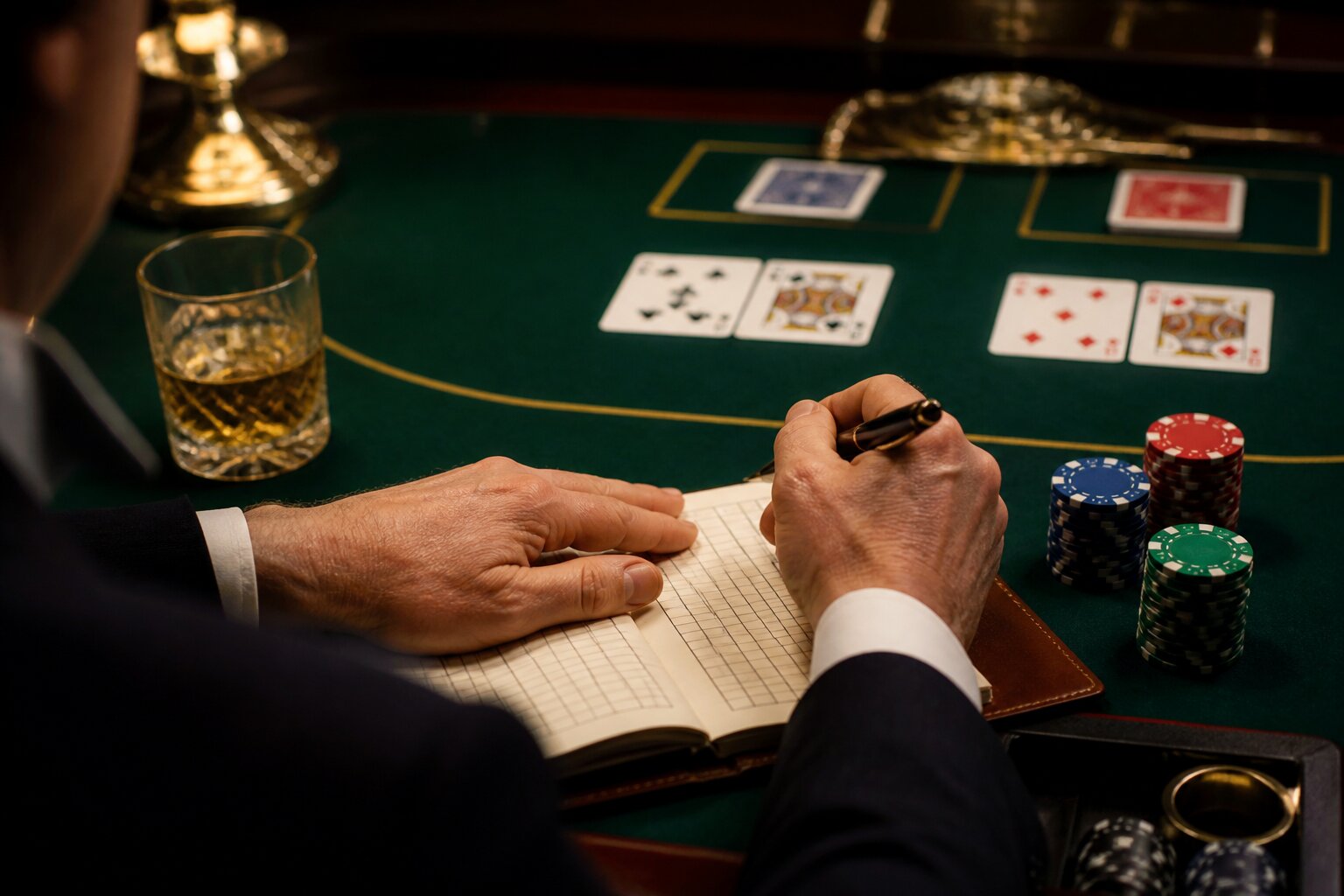
Ever wondered why so many people keep track of every point in baccarat? Those scorecards and careful marks aren’t just for show — they’re part of the game’s character and the way many players engage with it.
Whether you’re a casual observer or plan to take a seat at the table, understanding why players track points will change how you see the game’s rhythm and social side.
Curious about what the scores really mean and how they affect play? Read on to discover why keeping score in baccarat is more than a pastime for many players.
What Does It Mean to Keep Score in Baccarat?
Keeping score in baccarat means recording the outcome of each hand — whether the Banker, Player, or Tie wins. Players use scorecards or printed sheets provided at the table to note these results and follow the sequence of hands.
This practice, often called point tracking, isn’t about adding card values as in blackjack. Instead it records the winner of each round so patterns of results can be seen at a glance.
It’s important to understand that tracking results does not change the game’s mathematics. Each round is an independent event whose probabilities are fixed by the rules and card distribution. Many players track simply to follow the flow of the session and to feel more involved in what’s happening at the table. Note also that baccarat is for adults aged 18 and over; recording outcomes is a personal choice and a part of how some people enjoy the game.
Why Do Players Track Points During Baccarat?
Players track points for several practical and social reasons. First, marking results makes it easy to see the sequence of outcomes over many hands, which some find entertaining and engaging. It also gives a sense of continuity in a game where each hand is dealt quickly.
Second, the act of keeping a scorecard is often social. At a busy table, scorecards can start conversations and give everyone a shared focus. For players who like structure, the charts and grids offer a simple ritual that complements the pace of the game.
A third reason is habit and tradition. Baccarat has long attracted players who enjoy this kind of bookkeeping; for them it’s as much part of the experience as the chips and the dealer. While tracking can increase personal engagement, it’s not a technique that alters the underlying probabilities of the game.
How Is Scoring Calculated in Baccarat?
Baccarat uses a simple scoring system that is easy to learn, which helps when you are following results on a scorecard.
The Role of Point Cards and Totals
Card values are straightforward and worth memorising. The values are:
- Cards 2 through 9 are worth their face value.
- Aces count as 1 point.
- Tens and the face cards (Jack, Queen, King) are worth 0.
When two cards are added and the total is a two-digit number, only the last digit is used. For example, a 7 and an 8 combine to make 15, which becomes 5 when you drop the leading 1.
The objective is for a hand to total as close to 9 as possible. Hands that add up to 8 or 9 are called naturals and normally end the round unless rules require otherwise. That basic arithmetic is consistent whether you are watching a table in person or playing a digital version.
Because the scoring is so straightforward, recording winners (Banker, Player, Tie) on a scorecard is a practical way to capture the session’s flow without recalculating hand-by-hand totals. A simple scorecard helps you spot trends and patterns in results, but it is not a prediction tool and should be used only for record keeping.
Is Card Tracking a Myth or a Useful Practice?
Debate around card tracking centres on its usefulness versus its entertainment value. For some players, tracking adds a layer of meaning to the session: patterns on a sheet can feel satisfying to follow, and interpreting those patterns becomes part of the enjoyment. For others, tracking is a myth when it comes to influencing outcomes.
From a mathematical viewpoint, past results do not change the probability of future hands. That independence is why card tracking cannot produce a reliable advantage. Still, the practice persists because it enhances involvement, gives structure to play, and often acts as a social focus at the table. In short, card tracking can be useful for engagement but not for improving the odds.
Does Tracking Points Influence Game Outcomes?
Tracking points does not influence what happens in subsequent hands. Each round in baccarat is dealt and resolved independently, governed by the same dealing rules and card values every time.
Where tracking can have an effect is on the player’s behaviour. Recording results may encourage a player to stick with a certain betting approach or to change their stake based on perceived patterns. Those choices can affect an individual’s session — but that is a change in player behaviour, not in the game’s mechanics. So while tracking might shape how someone plays, it does not alter the underlying probabilities or the way cards are dealt.
If you find tracking makes you adjust bets more often, it’s worth being aware of that influence and deciding whether it improves your enjoyment or simply complicates your session.
Common Misconceptions About Keeping Score
A frequent misconception is that scorecards reveal a “hot” streak that will keep yielding the same result. In reality, the independence of each hand means past outcomes aren’t predictive. Another mistaken belief is that tracking can somehow reduce the house advantage; the game’s edge is set by the rules and payout structure, not by whether players make notes.
Some players expect detailed records to expose a favourable section of the shoe, but there’s no reliable evidence this works in practice. Much of the desire to find patterns comes from a natural human tendency to seek order; scorecards satisfy that urge but don’t change how the deck behaves.
Understanding these misunderstandings helps keep expectations realistic and focus on what scorekeeping actually provides: a way to follow the session and connect with other players.
Should Beginners Bother Tracking Points?
Beginners don’t need to track points to enjoy or learn baccarat. The core of the game is simple to grasp: how cards are valued and what determines a winning hand. New players tend to benefit more from observing the flow of a few hands, getting comfortable with terminology, and understanding how bets are settled.
That said, trying a scorecard casually can be a helpful way to stay engaged while you learn. It gives a visible record of outcomes that newcomers can use to familiarise themselves with how sessions progress. If it feels distracting or adds pressure, it’s equally fine to skip it and concentrate on basic play.
Whatever you choose, keep the experience within your means: set a wallet limit and take breaks if you need them. Tracking is optional and should support an enjoyable, controlled session rather than complicate it.
Benefits Beyond the Game: Social and Psychological Aspects
Beyond mechanics, scorekeeping brings social and mental aspects that many players appreciate. At a table, scorecards can be a focal point for conversation and shared observation, which helps strangers connect over the same activity. That social element can make sessions more engaging without changing the game itself.
On a psychological level, recording results provides a sense of order and involvement. For players who enjoy patterns and structure, the act of keeping notes offers mental stimulation and a small ritual to follow between hands. These benefits are about player experience rather than game advantage.
It’s worth noting that play should never be a strategy for handling stress or personal problems. If gambling begins to feel like a response to negative emotions, seeking help and stepping away is the responsible choice. Keeping play controlled and purposeful preserves the positive aspects of social connection and mental engagement that scorekeeping can bring.
**The information provided in this blog is intended for educational purposes and should not be construed as betting advice or a guarantee of success. Always gamble responsibly.