
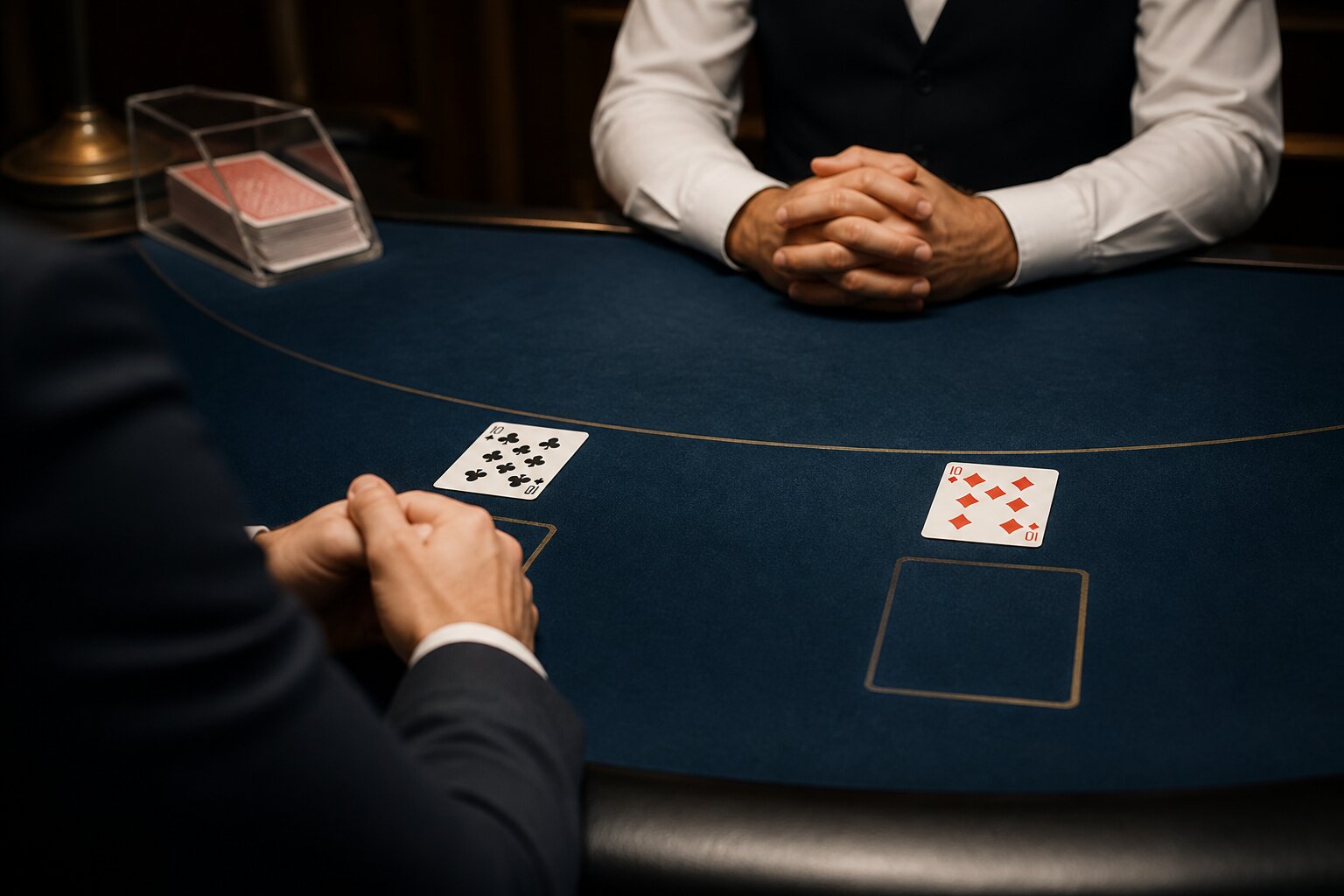
Ever wondered what happens in blackjack when neither you nor the dealer wins? That situation is known as a standoff.
If you want clearer knowledge for your next session at a table, understanding standoffs will help you know exactly what to expect when a hand finishes level. Read on and you’ll get a straightforward explanation of the term, how casinos handle it, and the typical scenarios where it appears.
Now let’s look at how a standoff works and why it matters when cards are compared at the end of a round.
Understanding the Basics of a Standoff in Blackjack
A standoff in blackjack, sometimes called a “push”, happens when both the player and the dealer have hands with the same total value at the end of a round. Neither side wins or loses that particular bet.
For example, if your final hand is worth 19 and the dealer’s final hand is also 19, the result is a standoff. After all players have acted and the dealer completes their turn, hands are compared and any tied totals are declared pushes.
When a standoff is declared, your original bet is returned to you in full. No additional winnings are paid and no funds are taken from your balance, so the round ends with your stake unchanged. Standoffs only occur when both hands are valid (that is, neither has exceeded 21); if one side busts, the usual win or loss rules apply.
This basic outcome keeps the game simple and fair for both player and dealer. Ahead we’ll examine how a standoff differs from wins and losses and what that means for your balance.
How Does a Standoff Differ from Other Outcomes?
A standoff is distinct because it leaves your balance exactly as it was before the hand began—unlike wins or losses, which increase or decrease your funds respectively.
When a hand is won, the player receives their original stake plus winnings, typically equal to the stake (so a £10 bet returns £20 on a standard even win). When a hand is lost, the stake is removed. A standoff, by contrast, results in no net movement of money: the stake is simply returned and play moves to the next round.
That neutrality is helpful: it avoids ambiguity about whether a hand counts as a win or loss, and it keeps settlement simple and consistent. Next, we’ll consider how UK casinos generally apply these rules in practice.
Common Casino Rules for Standoffs in the UK
UK casinos follow a straightforward convention for standoffs: the player’s original bet is returned with no deductions. This applies at both land-based tables and online games under UK regulation.
No commission is taken from the returned stake and no bonus is awarded for a push; the round is treated as a tie and play continues with the next hand. These standard procedures are publicly set out in casino terms and enforced under UK rules, which helps ensure consistent outcomes across different venues.
With those ground rules established, it’s useful to understand why standoffs happen in the first place and what influences them.
Why Do Standoffs Occur in Blackjack?
Standoffs are simply a consequence of the game’s mechanics: each side independently builds a hand aiming to be as close to 21 as possible without going over. Sometimes those independent decisions lead to matching totals.
Players decide whether to hit or stand based on their hand and the dealer’s upcard, while the dealer follows a fixed drawing rule. When those choices result in identical final totals—for example, both finishing on 18—that match becomes a standoff. The dealing order, number of decks in play and the particular sequence of cards dealt all affect how frequently ties occur, but the concept remains the same.
Understanding that standoffs are a built-in, neutral outcome helps keep expectations clear. Next we'll look at how wagers are settled when a tie occurs.
How Are Wagers Settled During a Standoff?
Settlement of bets in a standoff is simple and immediate. Once the dealer confirms that a player’s final total equals the dealer’s total and neither has busted, the hand is declared a push and the original stake is returned.
This process happens automatically at the table or within the game software online, and it applies to each player separately—so where several players tie the dealer, each affected stake is returned individually. The clarity of this settlement minimises any delay in play and ensures players know the status of their funds before the next round begins.
To see standoffs in context, the next section outlines the common situations in which ties arise at the table.
Typical Scenarios Leading to Standoffs
Standoffs appear in a range of ordinary situations during play; they are not unusual or exceptional. One typical scenario is simply when both you and the dealer finish with the same point total after all drawing is complete. If you stand on 20 and the dealer also reaches 20, the result is a push and your stake is handed back.
Another common case involves multiple players tying with the dealer in the same round. Each player’s hand is compared individually to the dealer’s: if three players and the dealer all have 18, each of those three players receives their bet back. The same rule applies regardless of whether players used different strategies to reach the tied total.
These scenarios demonstrate how standoffs are handled consistently for every participant. Next, we’ll clear up a few misunderstandings that sometimes surround these outcomes.
Misconceptions About Standoffs in Blackjack
Several myths about standoffs circulate among players. One is the idea that a standoff somehow improves or worsens chances in subsequent rounds; in reality, each hand is resolved independently and past pushes do not alter the underlying rules or deck composition beyond the cards already dealt.
Another misconception is that casinos retain a portion of a stake after a push. Under UK rules, a tie leads to full return of the bet—there is no hidden fee taken in that situation. Some players also mistakenly believe a push is rare or problematic; instead, it is a normal outcome reflecting equal hand totals and is treated neutrally by the game.
Clearing up these misunderstandings helps the game feel fair and predictable. With that background, consider how standoffs influence the overall experience at the table.
Impact of Standoffs on Game Experience
Standoffs contribute to the flow of a blackjack session by providing a clear, neutral resolution when totals match. Because settlements are rapid—stakes are returned straight away—play moves on without confusion or delay.
For players, the practical effect is stability: a push preserves the stake so one hand doesn’t change the bankroll, which can be helpful when evaluating strategy over several rounds. For dealers and casinos, consistent handling of pushes reduces disputes and keeps play orderly. All of this reinforces a sense of transparency in how outcomes are resolved.
Having considered practical effects, the final section below summarises the essential points you should remember about standoffs.
Key Takeaways on Standoffs in Blackjack
A standoff occurs when the player and dealer finish a hand with identical totals and neither has busted. In that event, the stake is returned in full and no win or loss is recorded for that round.
The result is neutral and handled consistently across regulated venues, with each player’s bet settled independently. Understanding this outcome helps you track your balance and keeps expectations clear during play.
Taken together, these points show that standoffs are a routine, transparent part of blackjack and are resolved in a straightforward way so you can move on to the next hand with a clear view of your position.
**The information provided in this blog is intended for educational purposes and should not be construed as betting advice or a guarantee of success. Always gamble responsibly.