
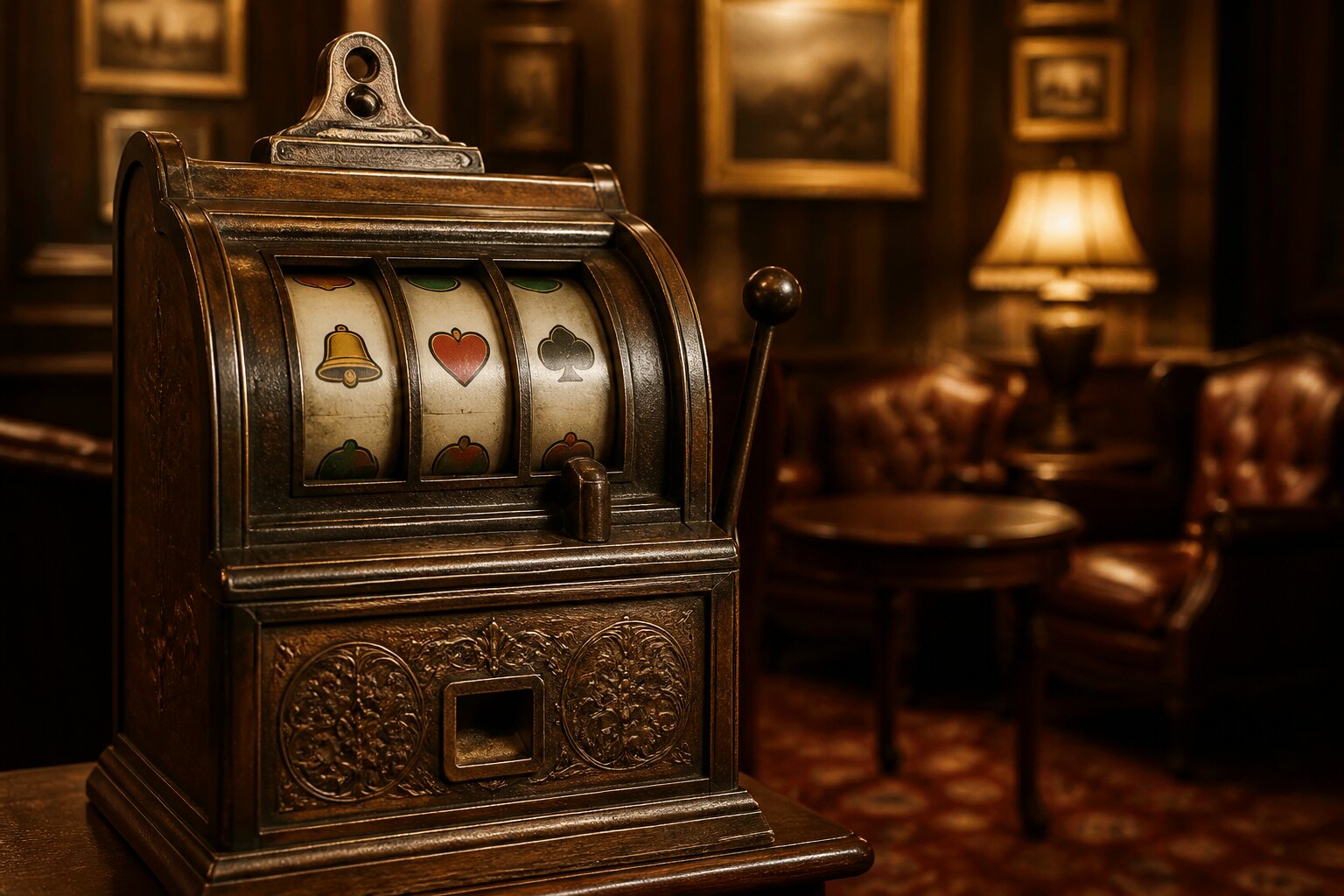
What if today’s high-tech online slots all began with a simple mechanical box over a century ago?
Slot machines have a surprising past shaped by clever inventors and steady technical change. From fruit symbols on metal reels to animated video slots on your phone, these games evolved steadily while keeping the same basic idea: spin, match symbols, and receive a payout when the machine’s mechanism allows it.
If you want to know where it all began, which machines mattered most, and how we moved from pub corners to polished digital games, read on — the story moves quickly from workshops to arcades and then to the web.
How Did Early Slot Machines Work?
The first machines were purely mechanical. Inside a cast-iron cabinet were a handful of reels, each printed with symbols. A player dropped in a coin and pulled a lever; that motion set gears and springs into action so the reels spun and then stopped, one after another. When the symbols aligned in a winning pattern, a mechanism released coins into a tray.
Because everything was physical, design choices were limited by space and engineering. Payouts depended on the number of symbol combinations and the machine’s internal coin storage. There were no animations, bonus rounds or complex soundtracks — just the satisfying clink of metal coins and the clear result of a mechanical process.
These designs offered no meaningful skill to influence outcomes; the result came from the machine’s mechanism. Over time engineers improved those mechanisms to be more reliable and to produce genuinely random outcomes by design rather than by chance of wear or misalignment.
That mechanical foundation shaped the basic player experience and informed later technical advances. Understanding that inner-workings helps explain why later developments — electrical parts, microchips, then software — focused on the same core elements: randomness, payouts and user interaction.
What Inspired the Creation of Slot Machines?
Slot machines emerged from a mix of social demand and available technology. In the late 1800s, people enjoyed simple mechanical amusements in public places: coin-operated trade stimulators that paid out drinks or tokens, and novelty machines that displayed miniature scenes. These were already familiar to pub and arcade visitors.
At the same time, poker-style mechanical machines showed that automating card games was possible, but they were more complex and needed an attendant. Inventors sought a simpler, self-contained device that could settle bets immediately and without supervision. Swapping card drums for rotating reels with symbols made the concept more compact and reliable.
Practical needs — speed of play, minimal staffing and robust mechanics — combined with improving metalwork and clockwork techniques to produce machines that were easy to manufacture and maintain. The result was a device designed first for convenience and entertainment, not as a financial scheme. That practical origin set the tone for how slots developed: straightforward to play, but underpinned by careful mechanical design.
Evolution of Slot Machines: From Mechanical to Digital
The long story from brass gears to software is one of incremental but decisive steps. Each innovation retained the original idea of reels and payouts while expanding what the games could offer players.
Electrical components arrived first, letting machines add lights and sounds and enabling more elaborate payout mechanisms without changing the basic reel concept. Later, microprocessors replaced much of the mechanical complexity. With programmable logic came Random Number Generators (RNGs), which produced results that could be independently tested and certified for fairness.
Moving to video screens untethered designers from physical reels, allowing imaginative themes, animated sequences and bonus features that are now central to modern play. The internet then made those video slots widely accessible from home or on mobile devices, while software platforms handled game logic, accounting and player accounts.
Each stage improved reliability, testing and transparency. As technology progressed, so did the systems used to verify fair operation and to offer players controls over their activity. These technical and procedural improvements are why contemporary games behave very differently from their mechanical predecessors, even when they retain the same look and feel.
Notable Technological Developments in Slot Machine History
The major milestones in slot technology did similar work in different ways: they increased feature scope, improved randomness and made machines easier to monitor. Electrical parts introduced attention-grabbing effects; microchips enabled certified RNGs and more complex pay tables; video and online platforms brought interactivity and greater variety in theme and reward structures.
Each change expanded what a slot could be while keeping the core mechanic — spin and match — intact. That continuity explains why modern games still feel familiar even as their technical backbone has completely transformed.
Electromechanical Slots
When electric motors and light arrays were combined with reels, machines became more theatrical and offered broader payout mechanics. The addition of electrical components allowed for more reliable payout sequencing and for features such as multiple coin denominations and automated credit meters, which made accounting simpler for operators and clearer for players.
The Microchip Revolution
Microchips shifted the brain of the machine from gears to code. With programmable logic, designers could map complex pay tables and control symbol weighting precisely. RNGs driven by microprocessors could be tested in labs and certified, which made results verifiable in a way purely mechanical machines could not match.
Video Slots and Online Play
Video technology removed the need for physical reels, letting developers create scenes, mini-games and cascading reels that were impossible in older machines. Online distribution took that variety to a much wider audience. Games could be updated more easily and audited centrally, and operators could offer responsible-play tools alongside the gaming environment.
These technological shifts also enabled better oversight and independent testing, a point that ties directly into how regulation and player protection developed over time.
How Did Slot Machines Become Popular in the UK?
Slots found a natural home in British leisure venues. Early in the 20th century they appeared in seaside arcades and on fairgrounds, and their recognisable fruit symbols gave them the nickname "fruit machines." The combination of brief play sessions, small payouts and the social setting of pubs and clubs made them an easy addition to local entertainment.
Legal changes over the decades formalised what machines could be found where and under what conditions. Regulations defined categories of machines, set payout and prize limits, and required testing to ensure machines worked as advertised. That regulatory framework shaped where machines could be placed — in arcades, bookmakers, pubs or casinos — and how operators managed them.
The move to digital and online expanded access, but the same principles applied: certified games, clear information about prizes, and tools for players to set limits or exclude themselves from play. The growing emphasis was on offering choice within a structured, supervised environment so adults could decide how and when to play.
If you’re curious how those controls look in practice, the next section explains how regulation and legal oversight developed to protect players and ensure fair operation.
Regulation and Legal Status of Slot Machines in Britain
Regulation has been central to Britain’s approach to slot machines from early licensing laws through to modern oversight. As machines became more widespread, lawmakers introduced rules to prevent unregulated gambling, to set machine categories and to ensure games were operated transparently.
Modern regulation requires independent testing of game software and of any random number systems. It also obliges operators to provide clear information about game rules, payout percentages and the controls available to players — such as deposit limits, session reminders and self-exclusion options. Operators must keep accurate records and submit to audits, so machines and platforms can be checked for compliance.
These safeguards grew alongside technology: when games became software-driven, regulators developed new testing standards and certification processes to keep pace. Today’s framework balances accessibility with oversight, aiming to protect players while allowing innovation in design.
Common Myths About the Invention of Slot Machines
A few persistent myths surround the early history of slot machines. One is that the first devices paid out large cash prizes; in reality, early machines more often dispensed drinks, tokens or small goods rather than large sums. Another is that they were crafted as schemes to make people wealthy — historically they were simple amusements designed for quick play.
Stories that paint the invention as secretive or the product of a single obscure genius overlook the historical record. While several inventors contributed to early designs, a key milestone was a late-19th-century machine that established the basic three-reel format and simple payout mechanisms. That template proved easy to copy and adapt, which is why it spread so quickly.
Separating these myths from documented developments helps us see the machines as practical inventions shaped by social uses and available technology, rather than magical devices or hidden tricks.
The Legacy of the First Slot Machines in Modern Times
The first slot machines created a blueprint that persists: clear rules, simple player interaction and the possibility of payout when certain combinations align. Modern games keep those elements but add layers of design, narrative and certified randomness that were impossible in the mechanical era.
Their legacy is visible not only in game mechanics and visual motifs, but also in the regulatory approaches that grew up around them. The need to verify fairness, to categorise machines and to provide player protections began with early legal responses and evolved into the testing and oversight we see today.
Contemporary games aim to balance entertainment with transparency and player controls. That balance is the lasting contribution of the first machines: they established a form that could be improved technically and supervised effectively, allowing slot play to remain a regulated leisure activity for adults.
**The information provided in this blog is intended for educational purposes and should not be construed as betting advice or a guarantee of success. Always gamble responsibly.