
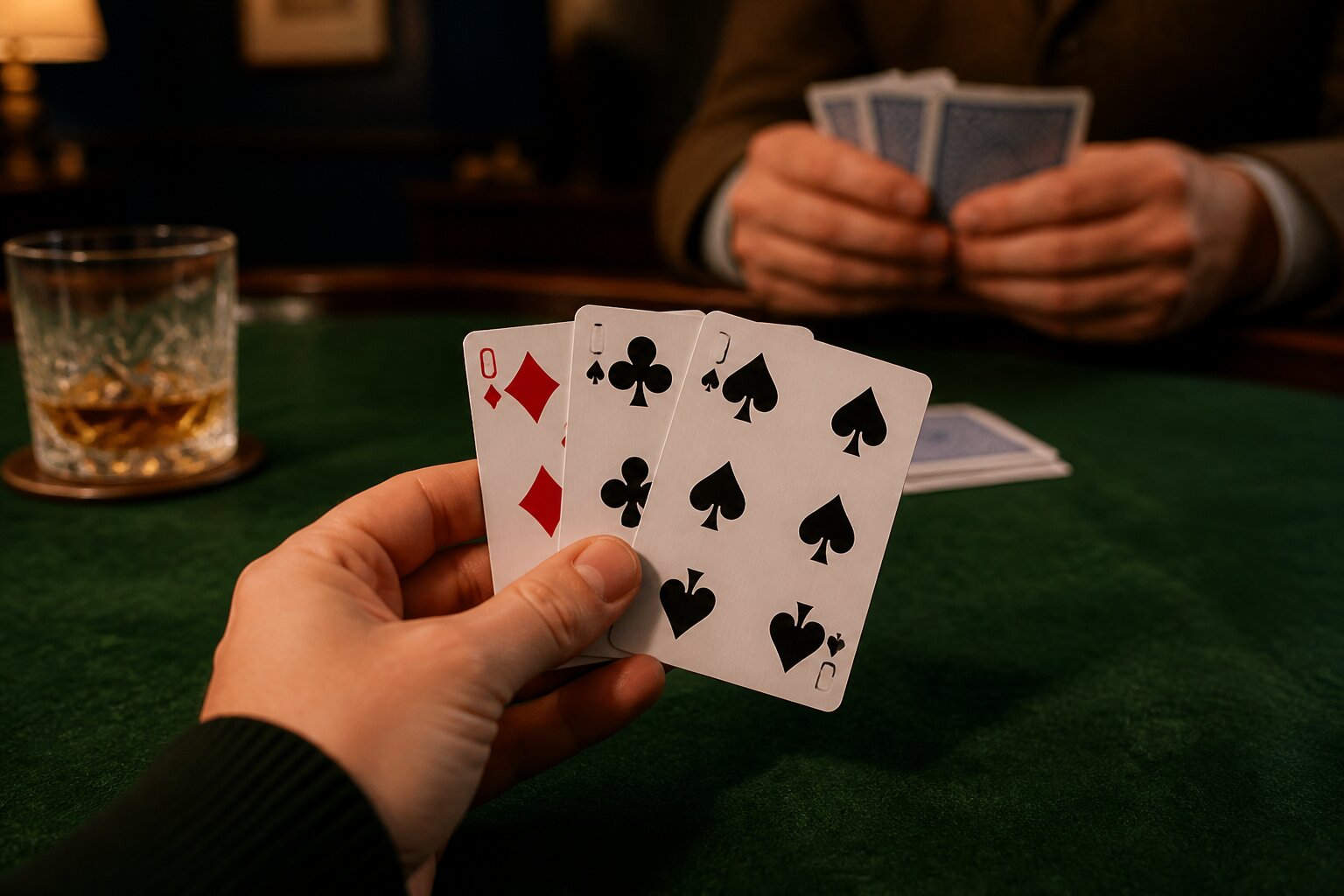
If you want to master 3 Card Brag, knowing the hand rankings is absolutely key. Whether you’re a curious beginner or looking to polish your skills, understanding which hands beat which can make all the difference.
Many players get caught out by the unique order of hands in 3 Card Brag — it’s not the same as poker. Make the wrong call, and you might lose chips you didn’t need to.
Ready to get confident with your next game? This guide sets out the essential hand rankings clearly and practically, so you can play with greater assurance. Let’s begin.
How Does Hand Ranking Work in 3 Card Brag?
Hand ranking is the system used to decide which player holds the strongest combination of cards during a round. Each player receives three cards and those combinations are ordered from strongest to weakest. The game compares these combinations once betting concludes to determine the winner.
The deal itself cannot be influenced by play; outcomes depend on the cards each player receives. When two players have the same type of hand, the comparison moves to the highest individual cards within those hands to break the tie.
Knowing this structure makes it easier to judge the strength of a hand in any situation and prepares you for the specific rankings that follow. Next, we’ll run through each hand type from top to bottom so you know exactly where your hand sits.
The Official 3 Card Brag Hand Rankings Explained
Hands in 3 Card Brag are judged by a clear hierarchy, from the rarest and most valuable down to the most common. Understanding each entry in that order is the basis for making good calls and recognising what to expect at showdown.
Prial: The Highest Hand in 3 Card Brag
A prial, also called a pair royal, is three cards of the same rank and sits at the top of the order. Examples include three threes, three aces or three kings. Within prials, the value of the rank determines which prial beats another — higher-ranked triples defeat lower-ranked triples. Prials are uncommon, which is why they outrank the other hands.
This rarity is what makes prials decisive when they appear and sets the stage for the next tier, the running flush.
Running Flush: When Three in a Row Matters
A running flush is three consecutive cards all in the same suit, such as 5, 6 and 7 of hearts. All suits carry equal value, so strength depends on the highest card in the sequence. A running flush will beat any run that is not suited, plus all lower hands.
Knowing how a running flush compares helps when assessing whether a hand just below it — for example, an unsuited run — can threaten higher combinations further on.
Straight Runs and Their Significance
A straight run, or simply a run, is three cards in sequence but of mixed suits, for example 2 of clubs, 3 of hearts, and 4 of diamonds. Its strength is likewise determined by the highest card in the run. Runs beat flushes, pairs and high cards, but lose to running flushes and prials.
Understanding where runs sit in the hierarchy clarifies why certain sequences should be treated more cautiously at the table.
Flush Versus Pair: What Comes Next?
A flush is three cards of the same suit that are not in sequence, such as 2, 6 and 10 of spades. Flushes outrank pairs and high cards but fall below runs, running flushes and prials.
A pair consists of two cards of the same rank plus one different card. When two players both hold pairs, the higher pair wins; if the pairs are identical, the remaining card — the kicker — decides the outcome. Both flushes and pairs have their own practical value in betting rounds, depending on how common they are in play.
High Card: The Lowest Possible Hand
A high card hand contains no pair, flush or sequence. The winner among high-card hands is decided by the highest individual card, then by the next highest if needed. For example, queen, eight and five of mixed suits would be queen-high.
High-card hands make up a large share of rounds, so recognising their relative weakness helps when weighing calls against other players. With the rankings clear, the next section explains exactly how these hands compare in practice.
What Beats What in 3 Card Brag?
The hierarchy is consistent: prial, running flush, run, flush, pair, high card. Any prial beats every other combination; any running flush beats runs and below; runs beat flushes and below; and so on down the list. This fixed order is the backbone of hand evaluation, so knowing it by heart reduces uncertainty when assessing your position in a hand.
When two players hold the same category, the highest-card comparisons described earlier decide the winner. For prials the value of the three of a kind determines the winner, and for running flushes and runs the sequence of the cards is compared from the top down. For pairs and high-card hands this often comes down to the kicker order, where the single unmatched card or the next-highest cards break the tie.
Keeping this ordered logic in mind makes table decisions more straightforward. It helps you separate outright stronger hands from those that only look promising, and it simplifies choices about calling, folding or otherwise responding at the table. Consistently applying the ranking and tie-break rules reduces mistakes and speeds up play.
Understanding common misconceptions about these relationships can prevent costly errors, so the next section clears up several persistent myths. That clarification will address misunderstandings about tie situations, the role of suits, and where deceptive hands might be overvalued.
Common Myths About 3 Card Brag Hand Rankings
One widespread myth is that a straight (run) ranks above a flush; in 3 Card Brag the run is higher than the flush. Another is that suits have different values — all suits are equal, so the heart on one table carries the same weight as a spade.
Some players assume aces are always the top rank for every purpose, but in prials the exceptional ordering of ranks places the best combinations differently — for instance, three threes are the top prial in certain traditional variants. Also, because hands contain only three cards, two pairs is an impossible outcome.
Finally, while it’s natural to look for patterns in past play, the correct approach is to assess each hand by its place in the hierarchy and the cards visible. With those misconceptions cleared, you’ll read the odds of various hands more sensibly in the next section.
Which Hands Are Most Commonly Dealt?
Frequency of each hand follows straightforward combinatorics: most deals produce high-card hands because there are many ways for three unrelated ranks and suits to occur. These hands are the default outcome in many rounds, so they form the baseline against which other hands are judged.
Pairs appear less often, since two matching ranks plus a different card are fewer combinations. Because pairs are more limited in number, they usually carry more value than a high card, but still fall well short of the rarer hands that require tighter coordination between cards.
Flushes, runs, running flushes and prials are relatively rare because they require tighter alignment of ranks and suits. Each step up the hierarchy demands more specific arrangements, which is why these hands show up less frequently in play. The relative scarcity of higher hands explains why a strong hand can win decisively, and why overvaluing mediocre holdings can be costly.
Knowing these relative frequencies helps with judgment in play, particularly when evaluating risk versus potential reward. Being aware of how often different outcomes occur makes it easier to assess whether a bet is justified or whether folding is the prudent option in a given situation.
Breaking Ties With Highest Cards
When players hold the same type of hand, comparison moves to the highest cards within those hands. For example, if two players each have a run, the run with the highest top card wins: a 4-5-6 outranks a 3-4-5. If top cards match, the second-highest is compared, then the third if needed.
For pairs, the pair’s rank is compared first; identical pairs are resolved by the lone third card. For flushes and high-card hands the same top-card comparison applies. This layered comparison is the standard method for settling close showdowns at the table.
Completely Tied Hands
If two or more players have hands that are identical in both rank and card values — including instances where card values and order match exactly — the hand is declared a tie and any stakes are typically split according to house rules. Such complete ties are uncommon but anticipated by the standard tie procedures.
A brief note on responsible play: keep wagers within limits you’re comfortable with and be mindful of play duration. With that in mind, use the ranking rules here as a practical guide to make clearer choices at the table and finish each session having made informed decisions.
**The information provided in this blog is intended for educational purposes and should not be construed as betting advice or a guarantee of success. Always gamble responsibly.