
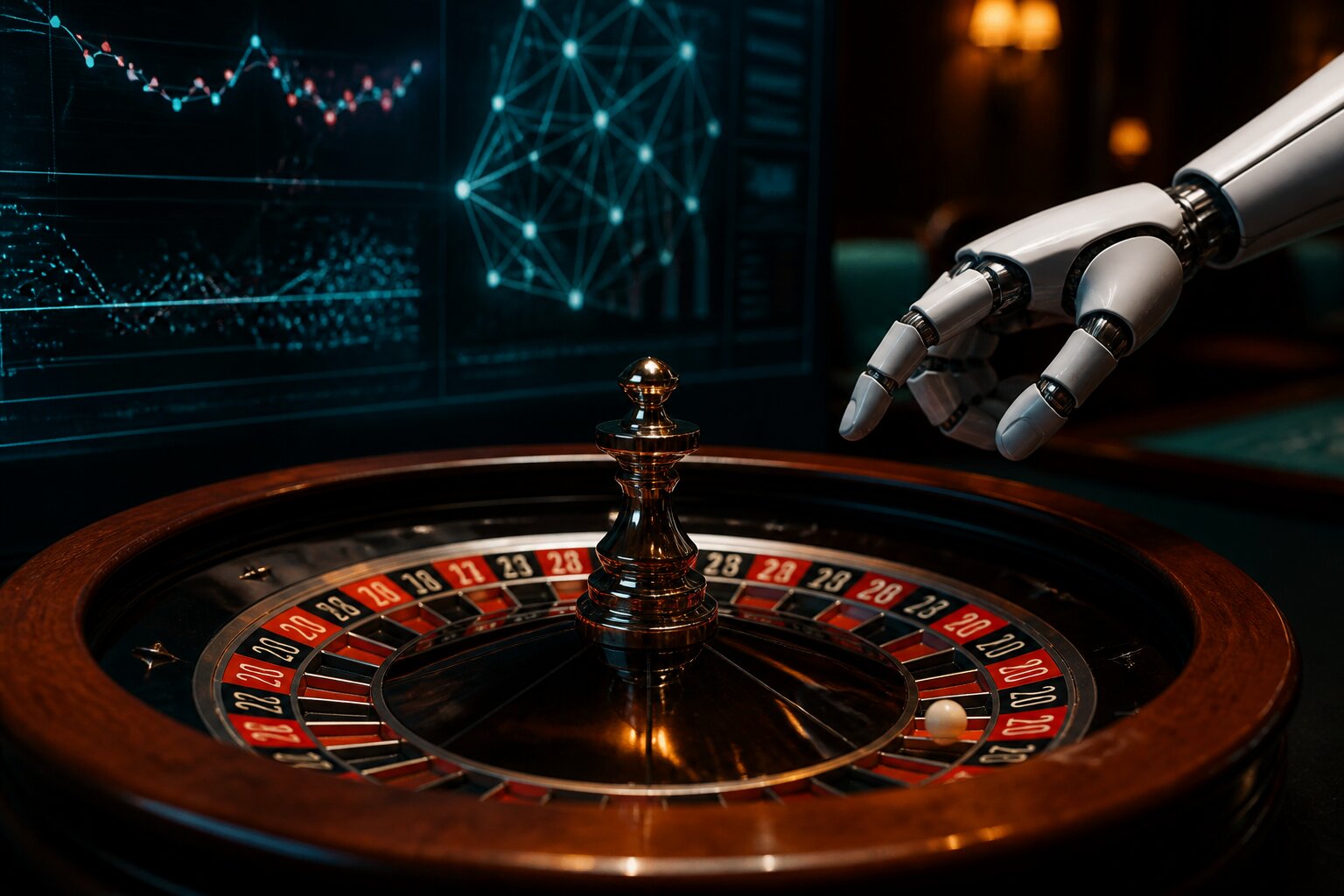
Have you ever watched a roulette wheel spin and wondered if there’s any way to predict where the ball will land? With advances in artificial intelligence and machine learning, the question has become more than a party-room debate — it’s a serious technical topic that attracts researchers, regulators and game operators.
This article explains how AI interacts with roulette, what the realistic possibilities are, and why the industry treats the game the way it does. Read on to separate practical capability from sensational claims and see where technology truly makes a difference.
How Does Machine Learning Work in Casinos?
Machine learning and AI are widely used across the casino industry, but their main roles are to support fair play, improve security and make the player experience more personalised — not to predict individual spin outcomes. Operators collect and analyse large volumes of data about gameplay and account activity, then apply models to spot trends and anomalies that help maintain a safe environment.
One common application is personalisation: algorithms can identify the types of games a player prefers and tailor offers or communications accordingly, so promotions are more relevant and less intrusive. Fraud detection is another key use. Machine learning systems examine transaction patterns and betting behaviour to flag suspicious activity quickly, helping to protect both the operator and other players.
There is also an important role in player protection. Systems can detect behavioural signs that suggest a player might be struggling and prompt non-intrusive support measures such as voluntary limits or reminders. These interventions are designed to be helpful without being punitive, maintaining player welfare while respecting individual choice.
These practical uses of AI strengthen security and fairness across casinos, setting the scene for a closer look at what AI cannot do when it comes to predicting individual spins. Before moving on to how randomness is treated in roulette, it helps to understand the core difference between analysing behaviour and attempting to forecast single, independent events.
Can Randomness in Roulette Be Analysed?
Roulette is structured so that each spin is independent of previous results. Whether the game is played on a physical wheel or an online platform, the outcome of one spin does not influence the next. This independence is central to how games are regulated and audited.
In bricks-and-mortar venues, physical factors such as the speed and angle of the wheel, the point at which the ball is released and tiny imperfections in the wheel surface determine where the ball eventually settles. Historically, some experiments tried to exploit these mechanical details, but modern wheels are maintained and checked to eliminate meaningful bias.
Online roulette relies on Random Number Generators that produce outcomes designed to be unpredictable and impartial. These systems are regularly tested and certified by independent laboratories to ensure each spin conforms to statistical expectations. Because of these safeguards, predictive power is effectively removed in digital environments.
Understanding these foundations clarifies why attempts to forecast spin outcomes face such steep obstacles; next, the practical factors that can influence a physical spin are explored in more depth.
Factors Influencing Roulette Spin Outcomes
In a physical roulette wheel, a mix of measurable elements affects the final number: wheel speed, ball velocity, spin direction and tiny irregularities in the wheel or ball track. Some experiments have used high-speed cameras and physics-based models to measure these variables and estimate probable landing zones. Even when several variables are recorded precisely, the system remains highly sensitive to small disturbances, making reliable long-term prediction extremely difficult.
Casinos mitigate physical bias by rotating wheels, replacing worn components and carrying out calibration checks. Any wheel showing a tendency to favour certain sectors is usually identified and corrected long before it becomes exploitable. In digital play, the RNG and auditing processes remove the physical element entirely, so those factors are irrelevant.
Taken together, these practical controls mean that while a single, rare mechanical fault might produce a detectable bias, modern maintenance and oversight are designed to prevent such opportunities. This leads naturally into the limits of trying to analyse purely random events.
Limitations of Analysing Random Events
Machine learning excels at finding patterns in large, structured data sets, but roulette’s design limits what patterns, if any, can be exploited. Because each spin is independent, historical results do not provide predictive power for future spins. Even with thousands of recorded spins, statistical noise and the intended randomness of the process make any apparent correlations unreliable.
Another constraint is data quality. For physical prediction attempts, measurements must be extremely precise and gathered under conditions that are hard to reproduce in a casino setting. For digital play, the RNG output is engineered to be cryptographically random and is subject to ongoing third-party testing, which blocks attempts to infer future outcomes from past ones.
Finally, regulatory and operational safeguards actively discourage and detect attempts to interfere with games. Between the statistical independence of spins, strict equipment maintenance, and robust auditing, the practical effect is that prediction efforts are unlikely to produce a repeatable advantage.
With those technical and operational limits in mind, it’s worth looking at historical and modern attempts to apply technology to roulette to see what lessons they provide.
Real-World Examples: Has AI Been Used to Predict Roulette?
There have been notable attempts to use technology to gain an edge at roulette. In the late 1970s a group of physicists experimented with discreet computational aids to model the motion of the ball and wheel. They reported some short-term successes under very controlled conditions, but their approach was cumbersome, unreliable and quickly countered by casino oversight.
More recent academic work has used video analysis and machine learning to examine whether subtle mechanical biases can be detected in casino wheels. A few studies found that a small number of older or poorly maintained wheels exhibited slight biases, but these were rare and generally corrected once identified. Online experiments demonstrate the opposite: digital roulette driven by certified RNGs offers no discernible signal that machine learning can exploit.
These examples make two points clear. First, early successes tended to rely on flawed or poorly maintained equipment rather than a repeatable predictive method. Second, continuous improvements in maintenance, surveillance and RNG certification have made such avenues effectively closed in contemporary settings. The practical upshot is that while technology can detect anomalies, it cannot reliably convert roulette into a deterministic game.
Are Predictive Models Reliable or a Myth?
Claims that predictive models can reliably influence roulette outcomes do not stand up to scrutiny. Mathematical analysis of the game shows fixed return-to-player figures determined by the game’s structure. For instance, the return in standard single-zero roulette is calculated from the distribution of payouts versus probabilities and does not change based on betting strategy or data analysis.
The house edge is a built-in feature of the game and represents the expected difference between player bets and long-run returns. Because outcomes are independent and payoffs fixed, no analytic system can eliminate that edge over a meaningful number of spins. Regulatory bodies and independent reviewers consistently advise that services or products promising guaranteed wins should be treated with scepticism.
Claims of reliable prediction also ignore practical enforcement. Operators monitor for irregular devices and trading patterns and take action if rules are breached. Beyond the technical impossibility, attempting to subvert game integrity can carry significant consequences for players and operators alike. The next section looks at those legal and ethical implications in more detail.
Legal and Ethical Considerations of Using AI in Roulette
Gambling law and regulatory frameworks require games to be fair and transparent. Using external devices, software or data-gathering methods intended to change outcomes or give a covert advantage breaches those principles and often the law. Operators have technical and procedural measures to detect tampering, and consequences can include voided wagers, account restrictions and potential legal action.
Ethically, preserving game integrity protects everyone who takes part. Attempts to manipulate outcomes undermine trust between players and operators and can harm the broader community. Responsible oversight balances players’ freedom to play with protections that prevent exploitation and ensure a level playing field.
Technology itself is neutral; how it is used determines whether it enhances safety and fairness or seeks to undermine them. With that ethical context in mind, it makes sense to consider how AI can continue to improve the player experience without compromising the game’s fundamental design.
What’s Next for AI and Casino Games?
The future of AI in the casino sector is focused on safer, fairer and more personalised experiences rather than attempts to predict game outcomes. Continued advances in behavioural analytics will enable earlier, more discreet support for players who might benefit from intervention, while improvements in personalisation will make offers and content more relevant without being intrusive.
Security and fraud prevention will also strengthen as models become better at recognising evolving patterns of misuse. Meanwhile, continuous auditing of digital systems and improved hardware maintenance for physical games will keep the underlying randomness and fairness intact.
Overall, innovation in the industry is aimed at enhancing entertainment value, protecting players and preserving trust. Technology makes those goals more achievable, while the core mathematics and regulation of roulette ensure the game remains what it is: a fair test of chance played on an even field.
Experience Casino Entertainment at Clover Casino
We’d love to welcome you to our site, where you’re invited to experience the world of casino entertainment in your own way and at your own pace. There’s always something to enjoy, whether you’re just beginning your journey or looking for something different.
Creating an account with us is straightforward—just register, make your first deposit, and you’ll be ready to explore our games. We look forward to seeing you enjoy your time with us at Clover Casino.
**The information provided in this blog is intended for educational purposes and should not be construed as betting advice or a guarantee of success. Always gamble responsibly.