
Ever wondered what your blackjack dealer is doing with the cards once the chips are pushed in and the hands are settled? There’s more to the routine than a quick mix — dealers follow set procedures that keep the game fair and orderly.
Whether you play occasionally or regularly, seeing how the shuffle works helps remove mystery and makes the whole experience clearer. Read on to learn exactly what happens, why it matters and how casinos keep the process secure and efficient.
If you’re ready to look at the practical steps behind the shuffle, we’ll start with the dealer’s basic technique.
How Do Blackjack Dealers Shuffle the Cards?
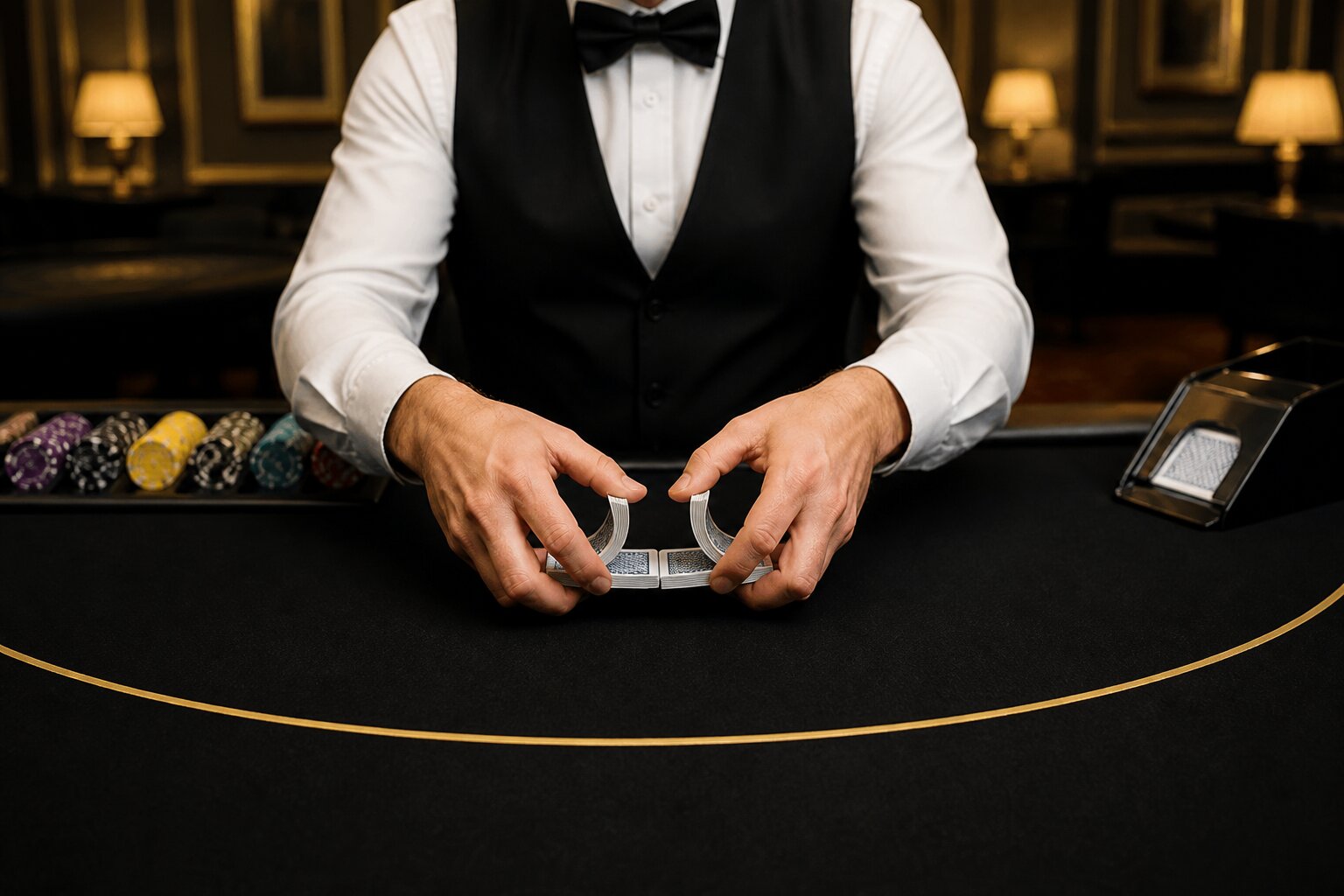
Dealers follow a sequence of actions designed to fully randomise the cards while keeping everything visible and above board. After a hand ends they collect the used cards and, if several decks are in play, combine them before mixing. Common manual techniques include riffle shuffles, where two stacks are interwoven, and strip shuffles, which move small packets around the deck to break up runs. These actions are repeated until the dealer and floor staff are satisfied the cards are well mixed.
In many venues, the dealer will complete the shuffle in front of players, using the table and shoe as points of reference so no off-table handling occurs. When automatic shufflers are used, the dealer simply places the cards into the machine and waits for it to finish. This maintains the same visible assurance while speeding the turnaround between hands. Next, we’ll look at how casinos stop any attempt to tamper with the cards.
What Methods Are Used to Prevent Cheating During Shuffling?
Casinos combine procedural rules, staff oversight and technology to protect the integrity of the shuffle. Dealers work to a strict code: cards stay on the table, handling is limited to approved moves, and any discarded or completed shoes are replaced to remove the chance of marked or switched cards. Floor supervisors conduct routine checks, and the shuffling area is kept in clear view.
Surveillance cameras record play and the shuffle so any irregularity can be reviewed. Many venues also use tamper-evident decks and automatic shufflers, which both reduce human contact and remove opportunities for subtle manipulation. These measures are aligned with industry regulatory expectations, ensuring consistency and accountability across tables.
Is the Deck Always Shuffled After Every Hand?
Shuffling after every single hand is not standard in most casino blackjack games. Instead, casinos often deal several hands from the same shoe and reshuffle when a predetermined point is reached — commonly indicated by a cut card or the end of the shoe. This approach balances the need for randomness with smooth play.
Some game formats, and many live-dealer online tables, do reshuffle more frequently or even after each hand; others rely on automatic shufflers that mix at set intervals. The chosen rhythm depends on the game format and operational priorities, and it’s visible to players so everyone understands how hands are prepared for play.
What Are Automatic Shufflers and How Do They Work?
Automatic shufflers are machines that rearrange cards mechanically or electronically to produce a thoroughly mixed deck without manual intervention. Dealers put used cards into the device and, after a short cycle, receive a shuffled stack ready for dealing. The machines are designed to randomise order while limiting human contact, which helps prevent accidental or deliberate manipulation.
Beyond increased speed, these units create a consistent standard of mixing that’s easy to audit. They’re particularly useful on multi-deck tables, where manual shuffling would be slower and more prone to inconsistency. With that in mind, the number of decks in play also changes how shuffling is handled.
Why Does the Number of Decks Matter in Shuffling?
The deck count alters both logistics and risk. Single and double deck games are easier to shuffle by hand, so operators may reshuffle more often to avoid detectable patterns. With fewer cards, dealers can reasonably perform thorough manual shuffles and cuts between deals, which helps maintain randomness and reduces the chance of predictable sequences emerging over time.
As the number of decks rises, commonly up to six or eight in many tables, the physical handling of cards becomes impractical. A shoe is used to hold those cards and manual riffling or multiple full shuffles by hand would be slow and often insufficient. Larger deck counts increase the number of possible card sequences and therefore require more rigorous shuffling and, often, mechanical assistance to achieve an acceptable level of randomness within the pace of play.
That need for efficiency and security makes automatic shufflers and clear cut-card procedures valuable tools. Mechanical shufflers speed up the process and can perform complex randomisation routines, while cut cards and similar procedures protect against marking or manipulative techniques. Both help keep the game running smoothly and reduce opportunities for tracking or manipulation, supporting fair play and operational practicality.
Common Misconceptions About Dealer Shuffling
There are several widespread myths about what happens at the table. One is that dealers can favour the house or certain players by arranging cards; in reality, visible procedures, staff oversight and surveillance make this virtually impossible without detection. Another is that players can time or predict when a reshuffle will happen to gain an advantage; casinos design triggers and cut points to avoid predictable patterns.
Understanding the reality helps set realistic expectations about fairness and reduces suspicion. With misconceptions cleared up, you can see how the shuffle affects the flow of play and what that means for the tempo around the table.
How Does Shuffling Impact the Pace of Play?
Shuffling directly affects how fast hands are dealt. Manual shuffles create short, natural pauses that give table action brief lulls; this can be useful for players to consider choices or for staff to manage the game. Automatic shufflers shorten those pauses, producing a steadier stream of hands and reducing downtime for both operators and players.
Operators aim to balance speed with clarity: shuffling methods are chosen to keep games moving while ensuring every hand begins with a properly mixed deck. This also helps maintain a consistent player experience, whether at a physical table or a live-dealer stream, and supports a safe playing environment through visible, auditable procedures.
Operators are committed to running games transparently and securely; the shuffle is one of the clearest examples of that practice in action.
**The information provided in this blog is intended for educational purposes and should not be construed as betting advice or a guarantee of success. Always gamble responsibly.