
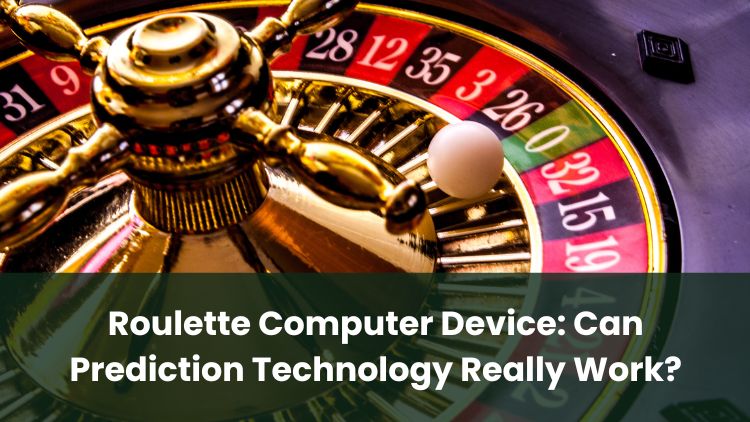
For many people, the idea of outsmarting a roulette wheel feels out of reach. Even so, some claim that prediction technology, especially roulette computer devices, can give a measurable edge by analysing how the wheel and ball behave.
But how far do those claims stand up? Can any device really forecast the landing area with dependable accuracy, and is using one even allowed in the UK?
This blog post explains how these devices operate, how they fare in real casino conditions, the types of technology involved, what the law says, how casinos counter them, and the common myths and technical limits that shape the reality.
Read on to learn more.
What Is A Roulette Computer Device And How Does It Work?
A roulette computer device is a small, concealed tool designed to estimate which section of the wheel a ball is most likely to land in. Typically worn or hidden on the user, it takes quick measurements of the wheel’s rotation, the ball’s speed, and often the wheel’s reference point, such as the position of zero at a given moment.
From there, the device applies calculations that model how the ball slows, when it is likely to drop from the track, and how far the wheel will rotate before the ball settles. The output is not a single number but a predicted sector, often communicated through discreet signals like tiny vibrations or audio cues.
These estimates rely on timely and accurate inputs. A brief delay or a misread speed can shift the predicted landing area by many pockets. No device can guarantee the exact pocket every time, but some aim to narrow the field. With the basics in place, it helps to look at the main kinds of technology used.
What Types Of Prediction Technology Exist For Roulette?
There are two broad approaches to roulette prediction technology. One involves equipment placed on or near the table, and the other relies on devices concealed on the person observing the game. Both aim to capture movement and timing, then turn that into a forecast.
On-Table Sensors
On-table sensors are positioned close to the roulette wheel to measure the motion of the wheel and ball, and sometimes to mark a reference position. The data is processed by a linked computer or a remote unit.
Because this method often requires placing or concealing equipment near the game, it usually relies on cooperation from someone who can access the table area. That makes it impractical in a normal casino and more common in private tests or demonstrations than in public play.
Wearable Devices
Wearable devices sit on the user, such as in a pocket, shoe, or disguised as everyday accessories. The user observes the spin and inputs brief timings, which the device processes before sending a subtle signal back with a suggested sector.
These devices live or die by accurate observations. If the timing is even slightly off, or the dealer varies the spin, the estimate can drift quickly. Even with clever design, performance in live play is another question entirely.
How Accurate Can Prediction Devices Be In Real Play?
Claims of high accuracy often fade when devices meet real casino conditions. Models that appear sound in a controlled test can struggle on a busy gaming floor, where everything from wheel speed to ball release can change from spin to spin.
Small measurement errors have outsized effects. Missing the right moment by a fraction of a second can move a predicted landing area by a large chunk of the wheel. Add in noise, crowds, reflections, and the pressure of entering timings discreetly, and even a well-built device faces a tough environment.
Casinos also vary procedures. Dealers may alter spin strength, rotate the ball at different speeds, or change how long the wheel is left to run before no more bets are called. All of this reduces the consistency that prediction tools rely on. That leads neatly to the specific factors that shape accuracy.
Factors That Affect Prediction Accuracy
Several variables influence how well a prediction device can perform in practice.
The condition and setup of the wheel matter. Even tiny changes to the ball track, the level of the table, or the size and material of the ball can affect where and when the ball drops. Regular maintenance, part rotations, and inspections are designed to keep results unpredictable and to prevent patterns from forming.
Timing precision is critical. Devices depend on catching exact reference points, such as how long it takes the ball to pass the same mark twice. A slight delay or an early press can translate into a different predicted sector entirely, particularly at higher wheel speeds.
Table procedures reduce predictability. Dealers can vary their spin, alternate directions, and change tempo between rounds. The timing of the call for no more bets can also shorten the window in which any device could gather useful information.
The wider environment then adds another layer. Busy tables, obstructed views, and shifting lighting make consistent readings harder. Casinos may also mix up routines or vary wheel and ball speeds to prevent any approach from settling into a rhythm.
Even if all these hurdles were overcome, there is a separate question to consider: the law.
Are Roulette Prediction Devices Legal In The UK?
Roulette prediction devices are not permitted in licensed UK casinos. Under UK law, using equipment to gain an advantage or interfere with the fair conduct of a game can amount to cheating, which is an offence under the Gambling Act 2005.
Anyone found attempting to use such devices can be removed from the premises, face potential criminal investigation, and be excluded from future play. Staff are trained to protect game integrity and to report suspicious activity to security and, where appropriate, to law enforcement.
Supplying or promoting equipment intended for cheating can also draw legal scrutiny. In short, using prediction technology at a roulette table in the UK is unlawful. With that in mind, it is useful to understand how casinos work to prevent it.
How Do Casinos Detect And Counter Prediction Devices?
Casinos invest heavily in game protection. Table staff are trained to spot unusual behaviour, such as rhythmic inputs, repeated glances at fixed points, or movements that suggest covert timing. Pit bosses and surveillance teams cross-reference what staff see on the floor with camera feeds from multiple angles.
Technical countermeasures can include radio-frequency detection to pick up unauthorised signals, along with targeted checks when behaviour appears out of the ordinary. Regular wheel audits, levelling checks, and ball changes help ensure that mechanical conditions do not become predictable.
Operational tactics then limit consistency. Dealers vary spin strength and direction, mix up the pace of play, and close betting at points that make mid-spin data gathering unreliable. Combined, these steps make it difficult for any device to collect the clean, repeatable measurements it would need.
With those realities in mind, it is worth clearing up some common misconceptions.
Myths About Roulette Computers Debunked
There are several well-travelled claims about roulette computers. A quick look at the facts helps set realistic expectations.
Myth 1: A roulette computer always guarantees a win.
No device can promise consistent outcomes. Minor timing errors, routine changes by staff, and natural variations in wheel and ball behaviour all undermine fixed predictions.
Myth 2: All casinos are vulnerable to prediction devices.
Modern casinos maintain and test wheels, rotate components, and use security procedures designed to prevent sustained patterns. Conditions are rarely stable enough for devices to thrive.
Myth 3: Using a roulette computer is entirely undetectable.
From trained observation to surveillance and electronic sweeps, casinos have multiple ways to spot unauthorised equipment or coordinated behaviour.
Myth 4: Prediction technology is legal for personal use in UK casinos.
It is not. Using devices to gain an advantage is unlawful and can lead to ejection, exclusion, and prosecution.
Technical Limitations Of On-Table Prediction Devices
On-table prediction systems, in particular, face practical barriers that are hard to overcome in real venues.
Precise placement is required. Sensors need a clear view or proximity to moving parts, yet tables are watched closely and regularly checked. Any attempt to install or conceal equipment risks immediate detection.
Consistency is elusive. Casinos clean, service, and level wheels, rotate balls, and replace components. Small changes to friction, balance, or ball weight can shift how the ball behaves, which means yesterday’s readings may not apply today.
Data quality and latency matter. Sensors must capture accurate timings and relay them without delay. Interference from other electronics, signal dropouts, or slight calibration drift can push the forecasted sector away from the actual result.
Finally, the human element remains. Crowded rails, restricted sightlines, and interrupted access to the table reduce the number of clean measurements a device can take. Even a strong model struggles without stable, high-quality inputs.
Taken together, these points explain why prediction technology rarely translates into reliable results in modern casinos. If you choose to gamble, only play with money you can afford to lose, and seek support if needed. GamCare and GambleAware offer free, confidential help.
**The information provided in this blog is intended for educational purposes and should not be construed as betting advice or a guarantee of success. Always gamble responsibly.