
Blackjack is a popular card game found in most casinos, but understanding which hands are better than others is not always obvious, especially for beginners.
Hand values shape every decision and outcome. Some combinations have specific names and may trigger special payouts, so it helps to know where each total sits.
This guide explains the strongest and weakest hands, what makes a natural blackjack stand out, how hard and soft totals work, how splitting pairs can change a round, and what happens when both sides finish on the same number. It also clears up a few common myths. If you choose to play, set firm limits and treat it as paid entertainment.
Blackjack Hand Rankings From Best To Worst
Understanding which hands stand above the rest is essential in blackjack. The rankings below outline the strongest to weakest hands a player might receive and how they typically compare during play.
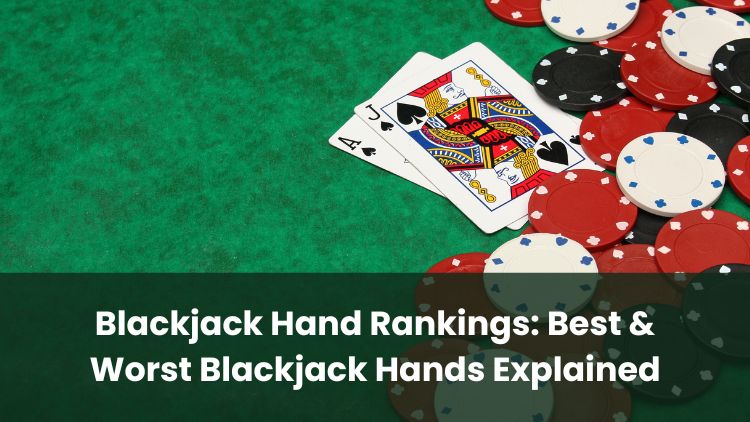
Natural Blackjack (Ace + Ten)
A natural blackjack is the best hand possible. It is an Ace and any 10-point card, dealt as the first two cards. This hand usually pays better than a standard win, often 3:2 in many UK casinos and online tables.
21 With Three Or More Cards
If 21 is reached with three or more cards, such as 7, 8, and 6, it is still a strong hand, but it ranks below a natural blackjack. It pays the regular amount rather than the enhanced payout.
20
A total of 20, for example, two tens or a King and a Queen, is a solid hand. Only 21 beats it outright, and 20 can still be matched by the dealer.
19
A 19, such as a 10 and a 9, is a good total but more vulnerable than 20. The dealer can beat it with 20 or 21, or push with another 19.
18
An 18 is reasonable, yet it can be outdrawn by a fair range of dealer totals. It often holds up better when the dealer’s position is weaker, but it is not a premium finish.
17 And Below
Totals of 17 or lower are much more likely to be beaten by the dealer. Many tables require the dealer to stand on 17, while some require a hit on soft 17. Hands of 16 or less tend to be uncomfortable because they sit in a narrow space between improving and going over 21.
Bust (Over 21)
A bust occurs when the hand totals more than 21. This is the weakest outcome, as it means an automatic loss regardless of the dealer’s final total.
With that ladder in mind, it is worth looking at what sits right at the bottom.
What Is The Worst Hand In Blackjack?
The worst possible hand in blackjack is a bust. Once a hand exceeds 21, the round is lost immediately and there is no way to recover during that game.
Very low and mid-range totals can also be fragile, especially when the dealer shows a strong upcard. Totals such as 12, 13, or 14 leave little room to improve without risking a bust, which is why they often feel uncomfortable.
With the lowest outcomes covered, it helps to understand the standout result at the top.
What Is A Natural Blackjack And How Is It Paid?
A natural blackjack happens when the first two cards are an Ace and any 10-point card, giving a two-card 21. It usually pays 3:2. For example, a £10 bet typically returns £15 in winnings plus the £10 stake.
Some tables offer different payouts, such as 6:5, so it is worth checking the rules before you start. If the dealer also has a natural blackjack, the result is usually a push and the stake is returned.
To see why some 17s behave differently from others, it helps to look at hard and soft totals.
What Are Hard Totals And Soft Totals?
A hard total is any hand without an Ace counted as 11, or where the Ace must be counted as 1 to avoid going over 21. For example, 10 and 8 is a hard 18. A hand like Ace, 9, 9 is also a hard 19 because the Ace must drop to 1.
A soft total is a hand where the Ace is counted as 11. For example, Ace and 6 is a soft 17. If a high card arrives that would otherwise bust the hand, the Ace can shift to 1 and the hand becomes hard. This flexibility is why soft totals play differently from hard ones.
Pairs bring another wrinkle, because they can be turned into two separate hands.
How Do Pairs And Splitting Affect Hand Strength?
Sometimes, the first two cards have the same value, creating a pair such as two 8s or two Kings. Most casinos allow players to split pairs into two separate hands by placing a second wager equal to the original stake. Each hand then receives an extra card and is played on its own.
Splitting can turn an awkward total into two better chances. For instance, splitting a pair of Aces gives the possibility of building two strong hands. Splitting 8s can help avoid a hard 16, which is often considered a difficult starting point. That said, splitting is not automatically beneficial. Two 10s make 20, which is already strong, so many players prefer to keep them together.
Rules vary. Some tables limit how many times pairs can be split, or restrict actions after splitting. A common example is split Aces, where many tables allow only one additional card on each Ace, and any 21 formed after splitting is usually paid at the standard rate rather than as a natural.
Once both sides have played their hands, ties can happen.
What Happens When Player And Dealer Have The Same Total?
If the player and the dealer end up with the same total, it is called a push. No one wins or loses, the stake is returned, and the round is recorded as a draw. This can happen with any total, including 21.
With the essentials out of the way, a few myths are worth clearing up.
Common Myths About Blackjack Hand Rankings Debunked
One common misunderstanding is that a 21 made with several cards is better than a natural blackjack. In reality, the natural ranks higher and usually pays more than a multi-card 21.
Another belief is that low totals are always doomed. While lower hands are harder to protect, the dealer’s outcome matters, too, and a round can still be won if the dealer goes over 21.
Some assume splitting any pair improves the situation. It can help in specific cases, but it can also turn a strong total into two weaker ones if the table rules or follow-up cards are not favourable.
There is also a myth that copying another player’s choices will bring the same results. Each hand is independent, and the mix of cards and dealer outcomes changes every round.
If you choose to play, set spending limits, take regular breaks, and only wager what you can afford to lose. If gambling affects your well-being or finances, seek support early. GamCare and GambleAware provide free, confidential help. Understanding how hands rank, how Aces change a total, and how pairs and pushes work puts you in a stronger position to enjoy the game on your terms.
**The information provided in this blog is intended for educational purposes and should not be construed as betting advice or a guarantee of success. Always gamble responsibly.