
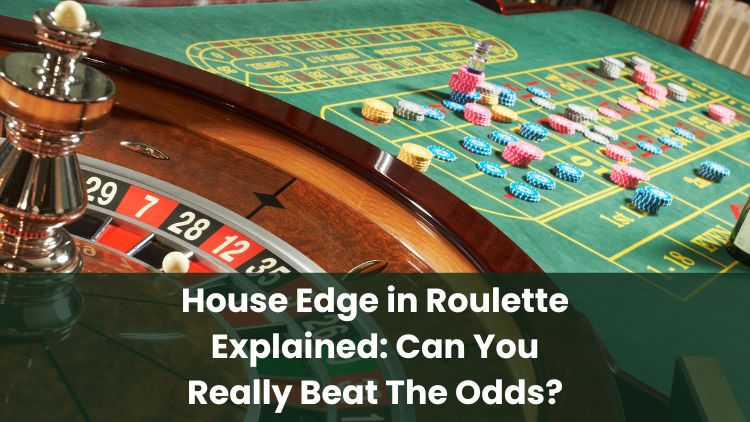
Roulette looks simple on the surface, yet its outcomes are shaped by a few key rules that often go unnoticed. At the centre of it all is the house edge, the built-in advantage that keeps the game profitable for the casino over time.
This article explains what the house edge is, how it is calculated, and how it applies to different bets. It also compares European and American wheels so readers can see how a single extra pocket changes the numbers.
By the end, the practical takeaways are clear, with common misconceptions addressed so expectations stay realistic and play remains responsible.
What Is The House Edge In Roulette?
The house edge is the casino’s mathematical advantage in roulette. It reflects the average amount the casino may keep from each bet over the long term.
This comes from the way potential payouts are set. The prize for a winning bet is always a little lower than the true chance of that outcome. For instance, a bet on red or black looks close to 50/50, but the green zero pockets tilt the numbers in the casino’s favour.
In short, the zero pockets create the edge. Understanding this helps explain why, over time, the game tends to return a profit to the house rather than to the player.
Curious how that percentage is worked out in practice? The next section breaks it down with simple examples.
How Is The House Edge Calculated?
The house edge is the gap between the true probability of a result and the potential payout offered for it.
Start with the wheel. European roulette has 37 pockets (1 to 36 plus a single zero). American roulette has 38 (an extra double zero). A straight-up bet on a single number, therefore, has a 1-in-37 chance on a European wheel, but it pays 35 to 1. That mismatch is where the edge comes from.
Expressed as a percentage, the house edge is about 2.7% on European roulette and about 5.26% on American roulette. Put another way, on a £1 even-money bet, the average loss over time is roughly 2.7p on a European table and just over 5p on an American table. The exact figure is found by comparing the expected return of each bet with the original stake.
With the calculation in mind, it helps to see how this applies to different bet types at the table.
What Are The House Edges For Common Roulette Bets?
On a European wheel with a single zero, most standard bets carry the same house edge of about 2.7%. That includes even-money bets such as red/black, odd/even, and high/low, as well as inside bets like single numbers.
On an American wheel with both zero and double zero, most bets carry a house edge of about 5.26%.
There is one notable exception on American tables: the “Top Line” or “Five Number Bet” (0, 00, 1, 2, 3). This carries a higher edge of 7.89% because the potential payout does not reflect its true probability as closely as other wagers.
If the edge is built in regardless of how you stake, the choice of wheel becomes an important consideration.
How Do European And American Roulette Compare?
European and American roulette look similar, but the extra double zero on the American wheel changes the maths and increases the house edge.
European Roulette With Single Zero
A European wheel has 37 pockets: 1 to 36 and a single zero. With only one zero in play, bets face a smaller disadvantage than on an American wheel. This is why many players prefer the European version when both are available.
American Roulette With Double Zero
An American wheel adds a double zero, taking the total to 38 pockets. That extra pocket increases the house edge and reduces the average return on the same types of bets compared with European roulette.
Knowing this difference sets up the key question many people ask next.
Can You Really Beat The Odds In Roulette?
Roulette is structured so the casino has an advantage that does not change with bet selection or staking patterns. Systems that change bet size after wins or losses cannot alter the underlying expectation.
Some strategies may create short runs that feel encouraging, but they are limited by the table’s minimums and maximums, and they do not change the probability of future spins. Each spin is independent of the last, so past outcomes do not influence what happens next.
Short-term results vary, but over time, the house edge asserts itself. Anyone choosing to play should only stake amounts they can comfortably afford to lose.
What Are Common Misconceptions About Beating Roulette?
A few ideas persist that do not hold up under scrutiny.
The first is that staking systems, such as doubling after a loss, can guarantee a profit. They may change how wins and losses are distributed, but the average expected return stays the same, and the house edge remains.
Another is that previous spins reveal patterns that can be used to predict what comes next. In a properly maintained game, each spin is independent.
Finally, some assume equipment bias can be spotted easily. Regulated tables are tested and monitored to prevent this, so relying on supposed bias is not a sound approach.
Keeping these points in mind helps set realistic expectations and supports more responsible choices.
Practical Implications For Players
Understanding the house edge means recognising that roulette is a negative-expectation game. No staking plan, betting pattern, or choice of numbers removes that built-in disadvantage.
If both versions are available, the European wheel generally offers a lower house edge than the American one. Checking the layout and the number of zeros is a simple way to assess this before playing.
Set clear limits on time and spend, and stick to amounts that are affordable within your budget. Taking regular breaks helps maintain perspective, and treating roulette as occasional entertainment can keep play in balance.
**The information provided in this blog is intended for educational purposes and should not be construed as betting advice or a guarantee of success. Always gamble responsibly.