
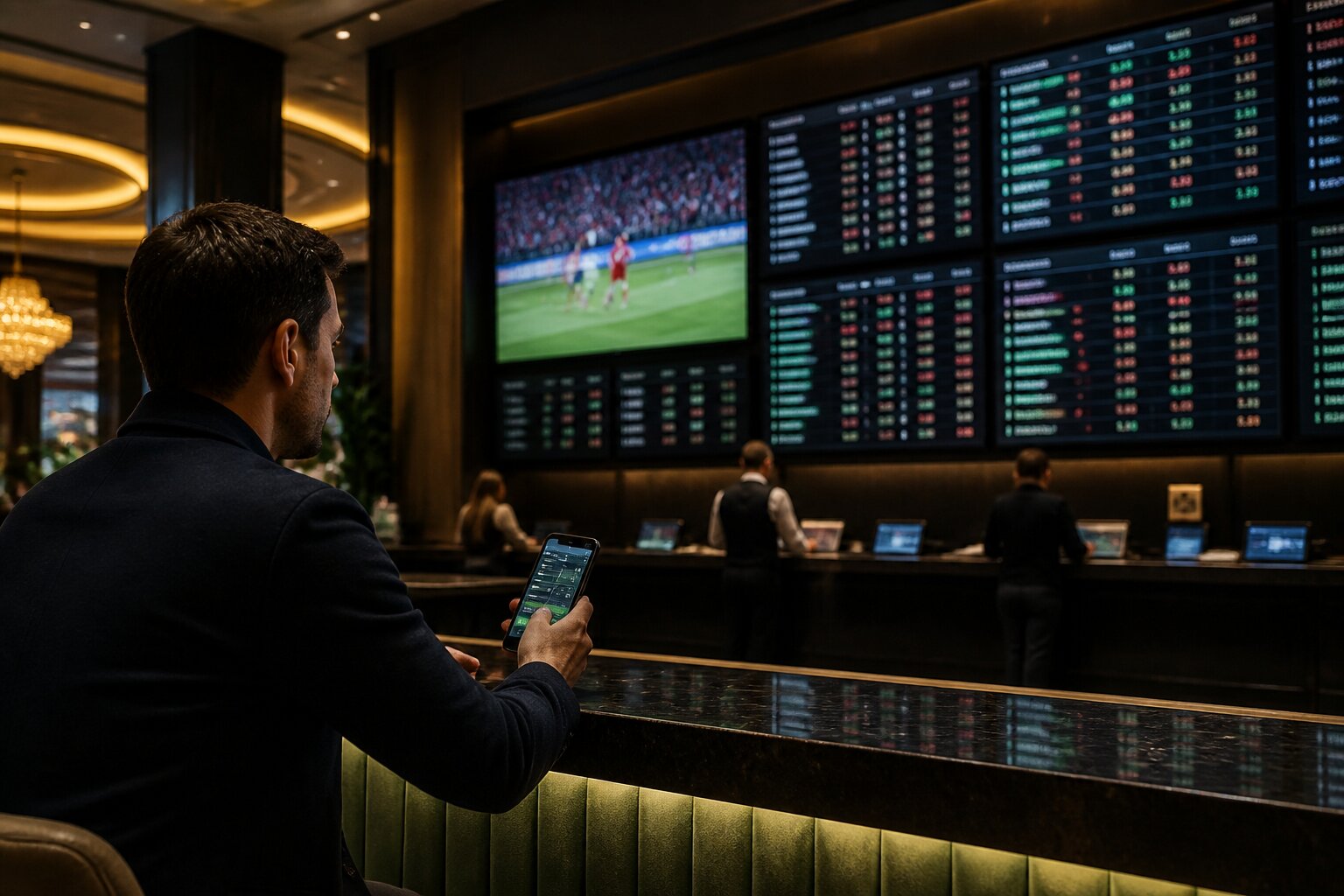
Have you ever wondered how casinos seem to maintain an edge in sports betting? Placing a bet can be thrilling, but there are clear business principles and statistical techniques behind the scenes that explain how sportsbooks stay viable while still paying out winners.
This article breaks down those methods in plain English. We’ll explain odds, margins, risk management and regulation so you can see why the house tends to come out ahead over time, and what that means for anyone placing a bet.
Read on to follow the mechanics that keep a sportsbook running and how they shape the markets you see.
How Do Sportsbooks Work?
A sportsbook is the arm of a casino or betting site that constructs markets for sporting events and accepts bets on those markets. Operators set prices, or odds, that express the probability of outcomes and include a margin that helps the business remain sustainable. These markets range from major football fixtures and horse races to niche events, all priced using data and statistical models.
Odds are regularly updated as new information becomes available — team form, injuries, weather or market movement — so the prices reflect current conditions. When customers place bets, those stakes are pooled against the posted odds; payouts are calculated according to those prices and the outcomes of the real events.
Licence-holders must meet regulatory requirements set by the UK Gambling Commission (UKGC). That involves protecting customer funds, verifying age and identity, and providing tools to manage gambling activity. Those safeguards are central to how licensed sportsbooks operate and are reflected in the way markets are presented to customers.
Having outlined how markets are created and maintained, we’ll next examine the core concept that underpins the operator’s profit: the betting margin.
What Is the Betting Margin?
The betting margin, often called the overround, is the percentage added into market pricing so that the implied probabilities of all outcomes total more than 100 per cent. That extra percentage is the operator’s margin and is what, over many bets, generates a steady return for the business.
For example, in a two-way market where each side looks equally likely, the raw probabilities might each be 50 per cent. If the odds are priced so each side implies 52.5 per cent, the total is 105 per cent and the 5 per cent above 100 is the margin. That margin contributes to covering operational costs, taxes and customer services, and it makes offering a broad range of markets sustainable.
Understanding the margin helps bettors interpret odds more clearly. It does not make individual outcomes certain, but it explains why average returns to players are slightly lower than the total amount staked over a long period. Next, we’ll look at how those margins are incorporated into the odds themselves.
How Do Odds Ensure Casino Profits?
Odds are derived from estimated probabilities, adjusted by the betting margin, and shaped so that the combined book produces a modest advantage for the operator. This edge is not a guarantee that every bettor loses, but rather a design that, across many markets and many customers, yields a predictable return.
Bookmakers employ statistical models, historical data and expert judgement to set odds as accurately as possible. They also monitor incoming bets and market signals to keep the book balanced and to limit exposure to a single outcome. Technology plays a big role, allowing prices to be updated quickly in response to new information.
Because the market is dynamic, some bets will win and others will lose; the margin ensures that the payouts, in aggregate, are aligned with the operator’s need to fund the service. With that balance in mind, the next section explores the concept of the house edge and how it translates into long-term returns.
The House Edge in Sports Betting
The house edge represents the numerical advantage embedded across the bookmaker’s range of markets. It is calculated as the difference between stakes collected and payouts made, expressed as a percentage. Over a large volume of bets, that percentage produces a predictable income stream for the operator.
Different sports and markets carry different edges: highly competitive markets with many operators often have slimmer margins, while obscure or volatile markets may have higher margins to reflect uncertainty and risk. The edge allows the business to remain solvent while continuing to offer markets and customer services.
Although the edge affects aggregate results, each event is decided by the real-world performance of teams or athletes. With that distinction established, the next section clarifies common terms used to describe this margin, and how they are calculated.
What Are Vig and Overround?
Vig and overround are two ways to describe the bookmaker’s margin. Vig, short for vigorish, is the commission-like element taken on bets. Overround is the way that commission shows up in the pricing: the combined implied probabilities of a market exceed 100 per cent by the amount of the overround.
Both terms refer to the same underlying concept but are used in slightly different contexts. Vig tends to be used when talking about the house taking a cut, while overround is used when discussing how those cuts are reflected in the odds. Either way, the presence of a margin means the odds offered are adjusted so the bookmaker has a theoretical advantage over the long run.
How Is the Vig Calculated?
Calculating vig involves converting the odds for each outcome into implied percentages and summing them. Any total above 100 per cent represents the vig. For instance, two outcomes each presented at decimal odds of 1.91 imply about 52.4 per cent each, giving a combined 104.8 per cent; the 4.8 per cent above 100 is the vig applied to that market.
You can also break this down further to see how much the bookmaker expects to keep on average. By removing the overround and normalising the implied probabilities, you can estimate the fair odds without the bookmaker’s margin. That process is useful for comparing prices between firms and identifying where value might exist, though it does not guarantee profitability on individual bets.
The Impact of Overround on Bettors
Because the overround reduces the theoretical return to players, it affects long-term profitability for bettors. It does not determine single-event results, but it does mean that a bettor’s expected return is slightly less than the raw probability would suggest. Over time small differences in margins can have a significant effect on overall returns, so understanding overround is important for anyone staking regularly.
Transparency around odds and margins helps customers make informed choices about where and how to place bets. Comparing overrounds across markets and bookmakers, and being aware of how margins change, allows bettors to choose more competitive prices and manage their risk exposure more effectively.
Having covered how margins are calculated and their effect, we’ll move on to the methods bookmakers use to manage exposure and keep their books balanced.
How Do Casinos Balance Their Books?
Balancing the book is the practice of managing how much money is staked on each outcome so the operator’s risk is spread and extreme losses are avoided. Operators do this by carefully pricing markets to attract stakes on both sides and by making ongoing adjustments as betting patterns emerge. The overall aim is to create a position where the operator’s liability is controlled and the built‑in margin, often referred to as the overround, secures a predictable return across many events rather than from any single market.
This work relies on a mix of statistical modelling, historical data and expert judgement. Models produce initial prices based on probabilities, but live markets rarely follow models exactly. Human traders monitor markets, spot anomalies or sharp money and apply judgement to decide whether a model needs recalibrating. Together, automated systems and traders form a feedback loop that keeps prices relevant to the current flow of bets.
Setting and Adjusting Lines
Initial lines are built from models, statistics and expert input. As wagering progresses, the distribution of stakes influences price movement: if a large volume backs one outcome, odds for that outcome may shorten while odds for the alternative widen. These movements are intentional. Shortening odds on a heavily backed outcome reduces the potential payout for new stakes on that side, while lengthening the other side makes it more attractive to opposing bettors, which helps to restore balance.
Lines are also sensitive to new information such as injury reports, team news or weather changes. Such updates can shift the perceived probability and lead to significant price changes even close to event start. Consequently, lines can move right up until an event starts, reflecting a continuous effort to keep markets accurate and manageable and to reflect the most up to date information available.
Minimising Risk and Securing Profit
Risk management techniques, including adjusting odds, limiting stakes and hedging exposure through lay‑offs with other firms or exchanges, help ensure the business remains viable. Limiting maximum stakes on particular markets or customers is a practical tool to prevent disproportionate exposure. Where a book becomes unbalanced, operators may lay off part of their liability with other bookmakers or on betting exchanges to reduce potential losses.
Hedging and active trading do not guarantee that every market will be profitable. Rather, the combination of a built‑in margin, disciplined limits and ongoing book management produces sustainable performance over time. Effective bookmaking depends on accepting some variance while ensuring that overall exposure is controlled and compliant with regulatory requirements.
Now that the mechanics of pricing and risk are clear, a common question is whether bettors can consistently beat these systems.
Is It Possible for Punters to Consistently Win?
Consistent long-term profit for most punters is rare. The margins and dynamic pricing in the market mean that even well-researched bets face a built-in headwind. Short-term wins do occur, but sustaining those wins over many events is difficult because the market prices outcomes to reflect available information and the operator’s margin.
Professional bettors sometimes find edges through superior data, sharp modelling or niche markets where prices are less efficient, but such advantages are typically small and short-lived as markets adjust. For the majority of customers, betting should be treated as an occasional interest rather than a reliable income source.
If managing stakes and expectations is important to you, the regulatory protections and tools mentioned earlier offer ways to control activity and keep it proportionate. With that context, the next section looks at myths that often cloud public understanding of how sportsbooks operate.
Common Myths About Sportsbook Profits
There are several persistent misunderstandings about how sportsbooks make money. One is that operators can influence event outcomes; real-world events are independent and beyond an operator’s control. Another is that the sportsbook wins every time; while the business has a margin, it can and does lose money on particular events.
Ideas of “foolproof” systems are also misleading. Because margins and unpredictable sport performance are factors, no betting system guarantees success across the long term. Finally, concerns about promotions being traps are often overstated; reputable operators design offers within regulatory rules and make terms clear, although customers should always read conditions and assess whether an offer suits them.
Clearing up these myths helps set realistic expectations and prepares readers to consider the final major area: regulation and fairness.
Regulation and Fairness in UK Sports Betting
UK sports betting is regulated to protect customers and ensure markets are fair and transparent. The UK Gambling Commission enforces rules covering licence conditions, customer checks, safeguards against underage gambling and the availability of self-exclusion and support tools.
Operators must demonstrate sound financial controls, clear advertising and robust complaints procedures. Regular audits and reporting ensure compliance, and choosing a licensed operator provides access to these protections. Regulation also means markets must be presented honestly, with information available so customers can understand odds, margins and any promotional terms.
These regulatory safeguards complete the picture of how sportsbooks operate: pricing and margins create a sustainable business model, active risk management balances exposure, and oversight protects customers and market integrity. Together they explain why operators can offer wide-ranging markets while remaining accountable and transparent.
**The information provided in this blog is intended for educational purposes and should not be construed as betting advice or a guarantee of success. Always gamble responsibly.