
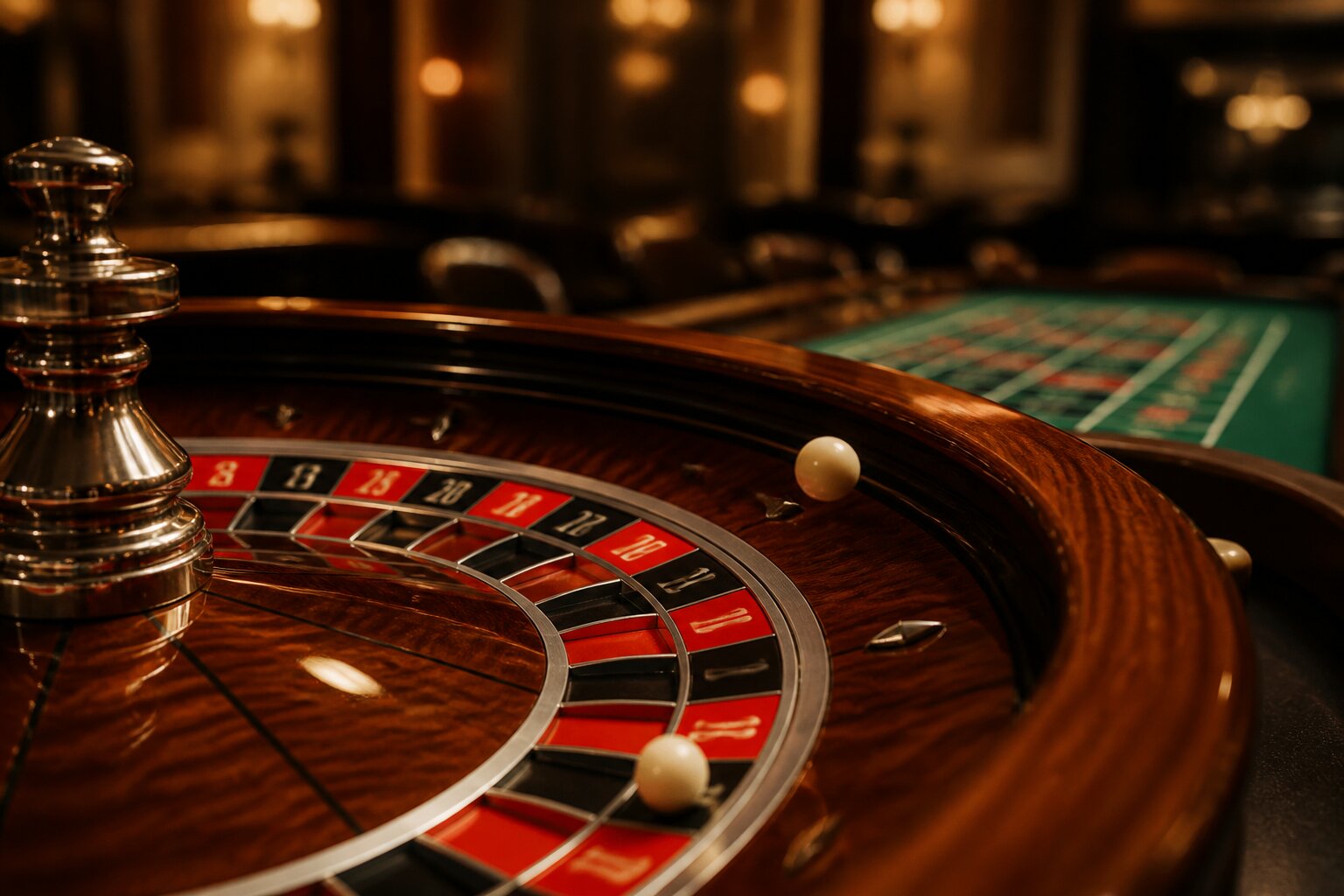
Ever watched the roulette wheel spin and wondered whether the same number could appear twice in a row? The sight of a repeat can be thrilling, but it also raises a clear mathematical question: how often should you actually expect it to happen?
This article breaks down the probabilities behind consecutive numbers, explains why repeats are so uncommon, and looks at real data to show how theory and practice match up. Read on to see what the numbers say and why each spin is its own event.
What Are the Odds of the Ball Landing on the Same Number Consecutively?
On a single-zero (European) roulette wheel there are 37 pockets—numbers 1 to 36 plus a 0. The chance of the ball landing on any particular number on one spin is 1 in 37, or about 2.70%. For the same number to appear on two successive spins, the maths multiplies those probabilities: 1/37 × 1/37 = 1/1,369, which is roughly 0.073%.
On a double-zero (American) wheel there are 38 pockets, so a single number has a 1 in 38 (about 2.63%) probability per spin. A repeat across two spins therefore comes to 1/38 × 1/38 = 1/1,444, or about 0.069%.
Each spin is an independent event with the same underlying probabilities; that independence is central to understanding why repeats remain infrequent. Next, we’ll unpack what independence and randomness mean for players and the house.
Understanding Roulette: Randomness and Probability
Randomness in roulette means every numbered pocket has the same probability on every spin, and past outcomes do not change those numbers. Probability provides the framework to quantify that behaviour: it predicts long-run frequencies rather than short-run certainty.
A helpful way to think about this is to compare roulette to other random processes. In those processes, runs or clusters of the same outcome can and do occur, but they do not alter the underlying likelihood of future events. For roulette, the predictable element is the house edge: on European wheels that edge is about 2.7%, and on American wheels it rises to about 5.26%. That figure summarises the long-term difference between bets paid out and bets taken in; it is not influenced by recent spins.
Understanding both independence and the house edge clarifies why betting strategies that rely on past spins cannot overcome the built-in mathematical advantage the casino holds. With that foundation in place, it is worth comparing the two common wheel types to see how the extra pocket affects outcomes.
European vs American Roulette: Does the Wheel Make a Difference?
The main structural difference between the two wheel types is the extra double-zero pocket on the American wheel. That single addition reduces the probability of any one number and increases the house edge.
Concretely, the chance to hit a specific number on one spin is 1/37 on a European wheel and 1/38 on an American wheel. For consecutive repeats this translates to the double probabilities calculated earlier: about 0.073% for European and 0.069% for American wheels for a double. The extra pocket therefore makes repeats marginally less likely and widens the casino’s advantage.
While the percentages change slightly between wheel types, the principle of independence remains the same. With that in mind, the next section looks at how these probabilities show up in real play and what monitoring data tells us about repeats in practice.
How Often Do Repeats Happen in Real Casino Play?
When casinos and independent trackers record thousands (or millions) of spins, the observed frequency of consecutive repeats tends to align closely with the theoretical figures. For European wheels, that will be near one double every 1,369 spins; for American wheels, around one every 1,444 spins. Short sessions can vary, with some seeing no repeats for many thousands of spins and others catching a repeat more quickly.
Live-streamed casino tables and online trackers provide ample examples where empirical data matches expectation over the long run, though individual sessions can be much more volatile. These real-world logs confirm that rare events, like doubles or triples, do occur but in the proportions probability predicts.
If repeats can and do appear in practice, how rare are longer streaks? The answer shows how rapidly the odds decrease with each extra consecutive hit.
Can Streaks Happen More Than Twice?
Longer streaks are mathematically possible but become very unlikely as each additional spin multiplies the improbability. On a European wheel a triple repeat is 1/37^3, which is about 1 in 50,653; a quadruple is 1/37^4, approaching 1 in 1.87 million. On an American wheel the corresponding figures are slightly larger denominators and therefore slightly less frequent streaks.
There are historical anecdotes of three or more identical results in succession at prominent tables, but these remain exceptional events and do not indicate any systematic bias in outcomes. With that rarity in mind, it helps to see the mathematics behind why repeats are so scarce.
Why Is It So Rare for the Same Number to Hit Repeatedly?
The scarcity of repeated numbers follows directly from how probabilities multiply. Each spin reintroduces the full set of possible outcomes; expecting the same narrow outcome repeatedly requires all those low probabilities to align in sequence.
For example, moving from a single event (1 in 37) to a double (1 in 1,369) to a triple (1 in 50,653) shows an exponential drop-off. The American wheel’s extra pocket compounds that effect slightly. Because probability compounds quickly, very long runs of the same number become astronomically unlikely, which is why such streaks are memorable when they do occur.
For more on how zero pockets affect payouts and odds, see 0 or 00.
Having seen the statistical reasons for rare repeats, it’s useful to address common misconceptions that often arise around them.
Common Myths About Roulette Repeats
Below are common misunderstandings about repeat numbers, explained clearly and succinctly.
- If a number has not appeared for a while, it is “due.” Each spin is independent, so prior absences do not increase the chance of appearance on the next spin.
- After a repeat, a number is unlikely to appear again for a long time. There is no rule preventing immediate reappearance; the probability on each spin is unchanged.
- Some numbers are inherently “hot” or “cold.” Short-term runs happen, but they do not change the long-term probabilities for any number.
- Betting systems can force or predict repeats. Systems may manage bankroll or bet sizes but cannot alter the underlying probabilities or the house edge.
These clarifications remove persistent misconceptions, and they close the loop on why repeats are both possible and uncommon. Ultimately, the mathematics gives a clear account of what to expect: repeats will happen, but only in line with the tiny probabilities outlined here.
Enjoy Casino Games at Clover Casino
At Clover Casino, we welcome you to discover the wide variety of entertainment waiting for you on our site. We take pride in offering an experience with something for everyone, whatever your tastes may be.
Getting started is easy – just set up your account, make a deposit and you’ll be ready to explore our range of casino games at your own pace. We look forward to having you with us soon.
**The information provided in this blog is intended for educational purposes and should not be construed as betting advice or a guarantee of success. Always gamble responsibly.