
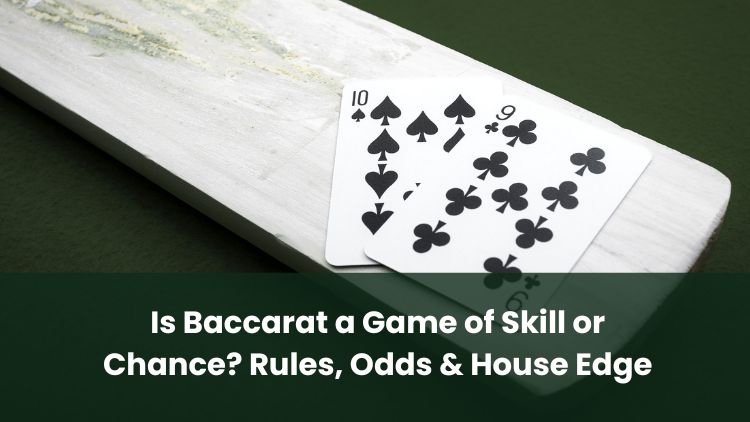
Baccarat is a popular card game often found at both online and land-based casinos. Its reputation for simplicity, combined with an air of sophistication, has made it a common choice for many players. However, questions about whether baccarat is influenced by skill or determined entirely by chance remain a topic of interest.
Understanding how baccarat works is important before deciding whether to take part. There are a few key rules, unique drawing conditions, and different bet types that shape the game’s outcomes. The odds and house edge for each possible bet may also affect how players approach the game.
This blog post explores the essential rules of baccarat, explains how the drawing rules function, covers the main bets with their payouts, and breaks down the house edge for each. It also looks at whether skill, strategies like card counting, or common misconceptions might influence the outcome, as well as the impact of different baccarat variants. Let’s start with how a round plays out.
How Is Baccarat Played?
Baccarat is simple to learn, making it accessible for those who are new to casino games. Players do not compete against one another; instead, they place a bet on whether the Player hand, the Banker hand, or a Tie will have a higher total.
The aim is for the chosen hand to have a total closest to nine. Each hand receives two cards to begin. The value of cards is straightforward: all number cards are worth their face value, 10s and face cards count as zero, and aces are valued at one. If the total is more than nine, only the last digit is used. For example, a hand of 7 and 8 totals 15, which counts as 5. A hand of 9 and 9 totals 18, which counts as 8.
Before any cards are dealt, players choose where to place their bet. After bets are placed, the dealer handles all aspects of the game. Once the cards are out, everything follows fixed rules, so there are no in-round decisions to make.
How Do The Drawing Rules Work?
Baccarat uses specific drawing rules to determine if either hand receives a third card. Unlike some other card games, players do not choose whether to draw an extra card.
If either hand totals eight or nine with the first two cards, it is called a natural and no more cards are drawn. If neither hand has a natural, the drawing rules come into effect. The Player hand draws a third card if the first two cards total 0 to 5. If the total is 6 or 7, it stands.
The Banker’s actions depend on both its two-card total and, if the Player drew, the value of the Player’s third card. In broad terms, the Banker draws on lower totals and becomes more selective as the numbers rise. For example, the Banker will always draw on 0, 1 or 2. With a total of 3, it usually draws unless the Player’s third card was an 8. At 4, the Banker draws if the Player’s third card was 2 to 7. With 5, it draws if the Player’s third card was 4 to 7. At 6, it draws only if the Player’s third card was 6 or 7. A Banker total of 7 stands. The dealer or software applies all of this automatically.
As soon as the hands are final, totals are compared and the highest total wins. With the mechanics set, the next step is understanding what the different outcomes pay.
Main Bets And Payouts
Baccarat offers three main betting options: the Player bet, the Banker bet, and the Tie bet. Each has its own payout rate and rules for determining the winner.
A Player bet is a wager on the Player hand having a higher total than the Banker hand. If this bet wins, it pays out at 1:1, meaning the winnings match the amount staked.
A Banker bet places a wager on the Banker hand having a higher total than the Player hand. This outcome also typically pays 1:1, but a commission of 5% is usually deducted from the winnings because the Banker hand has a slightly higher chance of winning.
The Tie bet covers the outcome where both Player and Banker hands finish with the same total. If this occurs, a standard payout is 8:1, though some casinos may offer 9:1. If a tie happens and you did not bet on Tie, Player and Banker bets are usually returned as a push.
Players can also find optional side bets in some games, but these vary and may come with different odds and payouts. Knowing the payouts sets the scene; the natural follow-up is how often each result appears.
What Are The Odds For Each Baccarat Bet?
Baccarat provides set odds for each main bet, as outcomes are based on the structure and rules of the game rather than player decisions. The figures below assume standard rules with an eight-deck shoe.
A bet on the Player hand has odds of winning around 44.62%. This means that over a large number of rounds, the Player hand tends to win a little fewer than half of them.
The Banker bet has slightly higher odds, with a chance of winning about 45.86%. This edge comes from the specific drawing rules applied to the Banker hand, which were outlined earlier.
A Tie bet is less likely to occur, with odds of around 9.52%. In practice, this means a tie appears fewer than 10 times in every 100 rounds on average.
Different tables or online games may offer additional side bets, each with their own odds. The core probabilities for Player, Banker and Tie remain steady when the standard rules are used.
House Edge On Each Bet
The house edge represents the statistical advantage that the casino holds over players for each bet in baccarat. Understanding these figures may help individuals make more informed decisions before playing.
A Banker bet has the lowest house edge, usually around 1.06%. This means that for every £100 staked, the casino stands to retain just over £1 in the long run. The 5% commission on Banker wins keeps this edge in balance.
A Player bet comes with a slightly higher house edge, typically about 1.24%. For every £100 staked on Player, the casino may retain around £1.24.
The Tie bet has a much higher house edge compared to the other main options when it pays 8:1, at about 14.36%. If the payout is 9:1, the house edge drops to roughly 4.85%, which is still higher than the Player or Banker bets.
Side bets, if offered, usually come with a higher house edge as well. That edge largely rests on how commission works in practice, so it helps to see how it is applied.
How Is The Banker Commission Calculated?
In baccarat, a commission is usually applied to any winning Banker bet. This commission is generally set at 5% of the winnings.
For example, if a player stakes £10 on the Banker and the bet wins, the standard payout before commission would be £10 in winnings. With a 5% commission, £0.50 is deducted by the casino, so the final amount received is £9.50 plus the original bet returned.
Some tables round commission to the nearest 10p or 50p, or track it on a small commission box and collect it when the player leaves the shoe. In live and online formats, the dealer or software calculates and deducts commission automatically.
The commission is applied each time a Banker bet wins, which is what keeps Banker and Player outcomes closely balanced from the casino’s perspective.
Do Different Baccarat Variants Change Odds Or House Edge?
Baccarat is available in several variants, each with its own rules and features. These differences may affect the odds and house edge for certain bets.
In standard Punto Banco, which is the most common version, the house edge and odds for Player, Banker and Tie bets are well established. Other variants, such as Chemin de Fer or Baccarat Banque, may involve different rules on who deals or draws the cards, but they are far less common online.
Mini Baccarat follows the same rules as Punto Banco, so you will not usually see a change in odds or payouts. Some specialty versions, like No Commission Baccarat, remove the traditional 5% on Banker wins. To offset that, specific outcomes are adjusted. A typical example is Banker winning with a total of 6 paying 1:2, or pushing, which changes the house edge on Banker compared with the standard game.
Speed Baccarat shortens the time between hands but does not change the underlying probabilities. Side bets that appear in some variants often carry distinct odds and a higher house edge than the three main bets. With the framework in place, the natural next question is whether personal skill can move the needle.
Can Skill Influence Baccarat Results?
Baccarat is mostly a game of chance, as outcomes are determined by the way cards are dealt. The dealer manages all actions, and players do not make decisions that affect how the cards are drawn or who wins each round.
Unlike games such as blackjack or poker, there is no opportunity for players to improve their outcome by using skill during the game itself. Once a bet is placed on Player, Banker or Tie, the result is decided by the cards and the fixed drawing rules.
The only real choice is which type of bet to place. Understanding odds, payouts and house edge can guide that choice and help with managing a budget, but it does not influence which cards appear.
Does Card Counting Work In Baccarat?
Card counting is a technique used in games like blackjack to keep track of which cards have already been dealt and estimate how the remaining deck might affect future rounds.
In baccarat, the structure of the game is different. The fixed drawing rules and limited decisions mean that counting has very little practical impact on the main bets. Analyses show that even with perfect information, any theoretical shift in advantage is extremely small.
In most online games, the shoe is shuffled after each round by the random number generator, so counting is not applicable. In live dealer settings and in casinos that use continuous shuffling machines or frequent deck changes, the effect is also neutralised. These realities cut through several popular ideas.
Common Misconceptions About Skill In Baccarat
Baccarat is sometimes thought to be a game where skill or strategy has a big influence. This belief often comes from comparisons to other card games where player choices shape the outcome.
One common misconception is that betting patterns or systems can change results. In practice, the result of each hand is determined by the deal and the fixed drawing rules, not by bet sequencing.
Another is that observing previous outcomes, or following “hot” and “cold” streaks, helps predict what comes next. Baccarat hands are independent events, so past results do not affect future ones. Similarly, card counting offers no meaningful advantage in typical baccarat formats.
If gambling starts to affect your well-being or your finances, seek support early. Independent organisations such as GamCare and GambleAware offer free, confidential help.
Understanding the rules, odds and house edge sets clear expectations. If you choose to play, keep it within your means and treat it as occasional entertainment guided by the facts above.
**The information provided in this blog is intended for educational purposes and should not be construed as betting advice or a guarantee of success. Always gamble responsibly.