
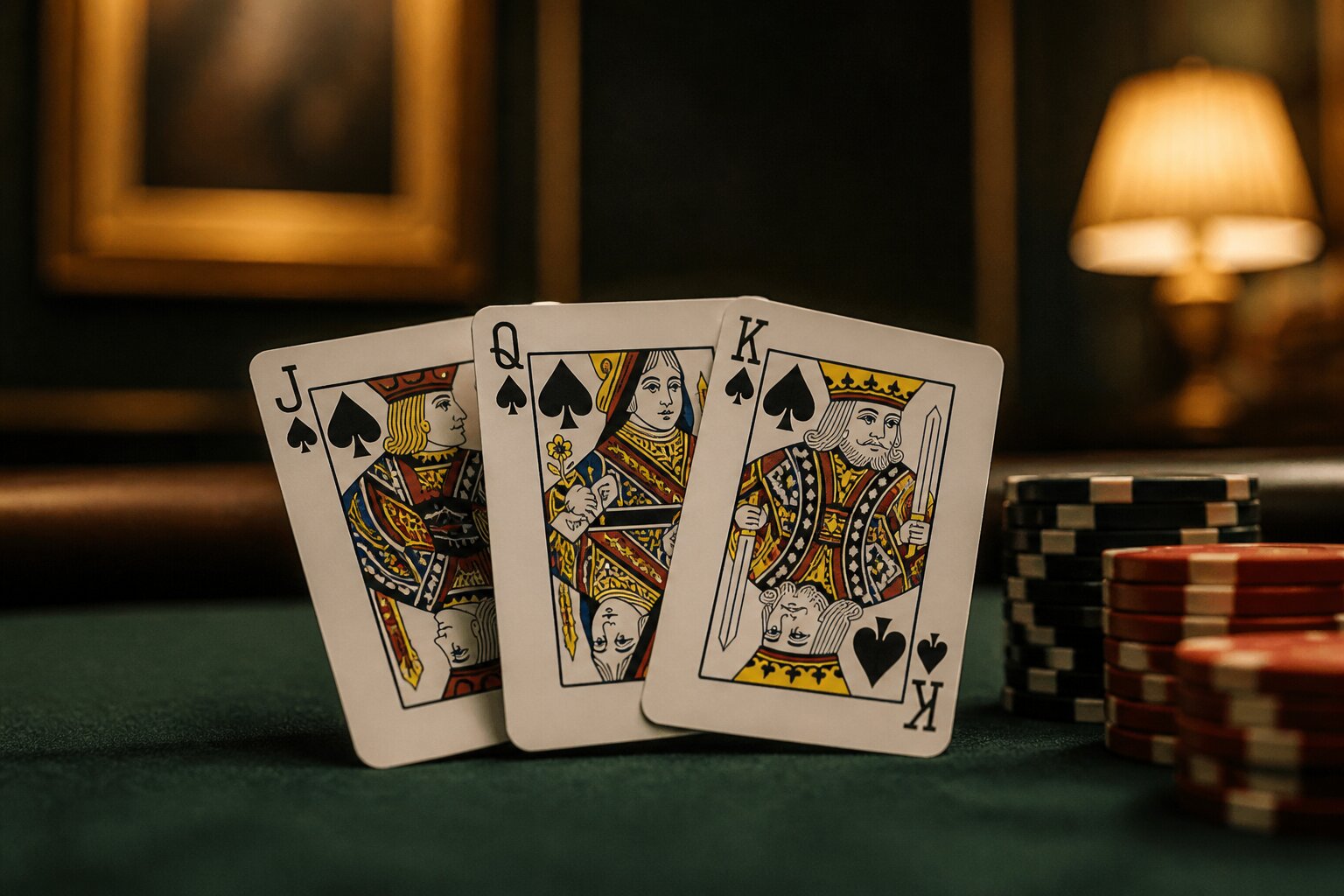
If you’re new to blackjack or want to brush up, knowing the value of every card in the deck is the first step to playing with confidence. Face cards — Jacks, Queens and Kings — play a particular role in how hands add up, so it helps to understand them from the start.
This guide explains exactly what each card is worth and how those values combine into a hand you can evaluate quickly. Read on and you’ll have a clear picture of the rules and what they mean for your play.
Face Card Values in Blackjack: What You Need to Know
In blackjack, the Jack, Queen and King are all classified as face cards and each is worth 10 points. That value is fixed and does not change with suit or context. A King of hearts is worth the same as a Jack of clubs.
This contrasts with the Ace, which can count as either 1 or 11 depending on which value keeps your hand at or under 21. Because the Ace is flexible, its interaction with face cards is important to recognise: an Ace plus any face card or a 10 gives you a two-card 21, commonly called blackjack.
Knowing that face cards are always worth 10 makes it easier to assess hands at a glance. For example, two face cards equal 20, a face card plus a 9 equals 19, and a face card plus another 10-valued card also totals 20. Those simple sums speed up decisions during play without needing to calculate suit or other details.
Being familiar with these values helps you understand basic outcomes and payoffs. It also makes clear why the presence of many 10-valued cards in the deck influences the likelihood of certain totals appearing, which is useful for general awareness of how hands tend to form.
How Do Numbered and Ace Cards Compare in Value?
Numbered cards — 2 through 10 — are worth their printed value. A 7 always contributes seven points, a 4 always four, and so on. These cards are the most straightforward to score and make up the backbone of most hands.
The Ace is flexible: it can be tallied as 1 or 11 based on which suits the total best without exceeding 21. This flexibility creates what players call a soft total, where the Ace can change value to prevent a bust. If counting the Ace as 11 would push the hand over 21, it is instead counted as 1.
That flexibility is what gives Aces special strategic value in many hands, particularly when paired with a 10-value card to form a “blackjack” (an Ace plus any 10-point card). A blackjack is the strongest two-card hand in standard play rules and is treated differently from a regular 21 made with more than two cards.
If you remember the basic values, you will cover the arithmetic of any hand:
- Face cards (Jack, Queen, King) are always worth 10.
- Numbered cards match their printed face value.
- Aces can count as either 1 or 11, whichever keeps the hand best without exceeding 21.
Why Are Face Cards Important in the Game?
Face cards are important because their consistent 10-point value makes them central to many high totals and to the classic blackjack combination with an Ace. Hands that include face cards are straightforward to add up, which can speed decision-making at the table.
Although face cards often stand out visually, they are simply one part of the deck’s composition. Their value contributes to hand totals in predictable ways, but they do not provide special bonuses beyond forming 10-value totals or blackjack combinations.
Common Myths About Face Cards in Blackjack
A frequent myth is that face cards follow patterns that can be anticipated. In practice, each deal is independent, so previous occurrences don’t determine future ones.
Another misconception is that face cards inherently improve your odds more than other cards. While they do create many strong hands because of their 10-point value, they function the same as any other card in the deck when it comes to how totals are calculated.
How Card Values Affect Your Hand Total
The objective in blackjack is to form a hand total as close to 21 as possible without exceeding it. Each card you receive adds its value to the total: numbered cards add their number, face cards add 10, and Aces add either 1 or 11.
When the initial two cards are dealt you quickly see whether the hand is already strong — for example, an Ace plus a face card is a blackjack — or whether further cards may be needed. As cards are added, totals change in ways you can calculate easily once you remember the fixed and flexible values described earlier.
If your total does exceed 21, the hand is a bust and the round ends for that hand.
What Happens If You Draw Multiple Face Cards?
Multiple face cards in a hand each count as 10 points. So a King and a Queen combine for a total of 20. There is no additional bonus for having several face cards; they simply contribute their fixed values to your total.
If you draw three face cards, their combined value would be 30, which is over 21 and would normally be a bust. However, the presence of an Ace in the same hand can alter that outcome, since an Ace may be counted as either 1 or 11 depending on what keeps your total within 21.
Because face cards often form high totals quickly, a hand with two or more of them can be very strong when the total is 20, or it can require careful judgement if other cards push the total near or over 21. Players should consider the dealer’s visible card and the flexibility provided by any Ace when deciding whether to stand or ask for another card.
Playing Blackjack in the UK: Card Values and Local Rules
When playing in the UK, whether in a venue or online with regulated operators, card values remain the same: numbered cards equal their face value, face cards are 10, and Aces can be 1 or 11.
Games are usually played with one or more standard 52-card decks. Some tables use a single deck, others use multiple decks in a shoe; the number of decks can affect certain strategic decisions but not the basic card values. Typical table rules include dealer draws to 16 and stands on 17 or higher, with a blackjack (Ace + 10-value card) commonly paying 3:2, though specific payouts and small rule variations can differ by table. It’s sensible to check the table’s rules before you start.
Most operators provide tools to help control play, such as deposit limits and time-outs. Make use of these features to keep play within personal boundaries.
Summary of Blackjack Card Values
This quick recap covers the essentials you’ll need at the table.
Quick Reference Guide
Numbered Cards (2–10): Worth the number shown on the card
Face Cards (Jack, Queen, King): Always worth 10 points each
Ace: Can be worth 1 or 11, depending on what’s best for the hand
With these values in mind you can add hands quickly and judge common situations, from a starting total to the potential for blackjack. Remember that each deal is independent, so focus on understanding the rules and using the available controls to manage how you play.
**The information provided in this blog is intended for educational purposes and should not be construed as betting advice or a guarantee of success. Always gamble responsibly.