
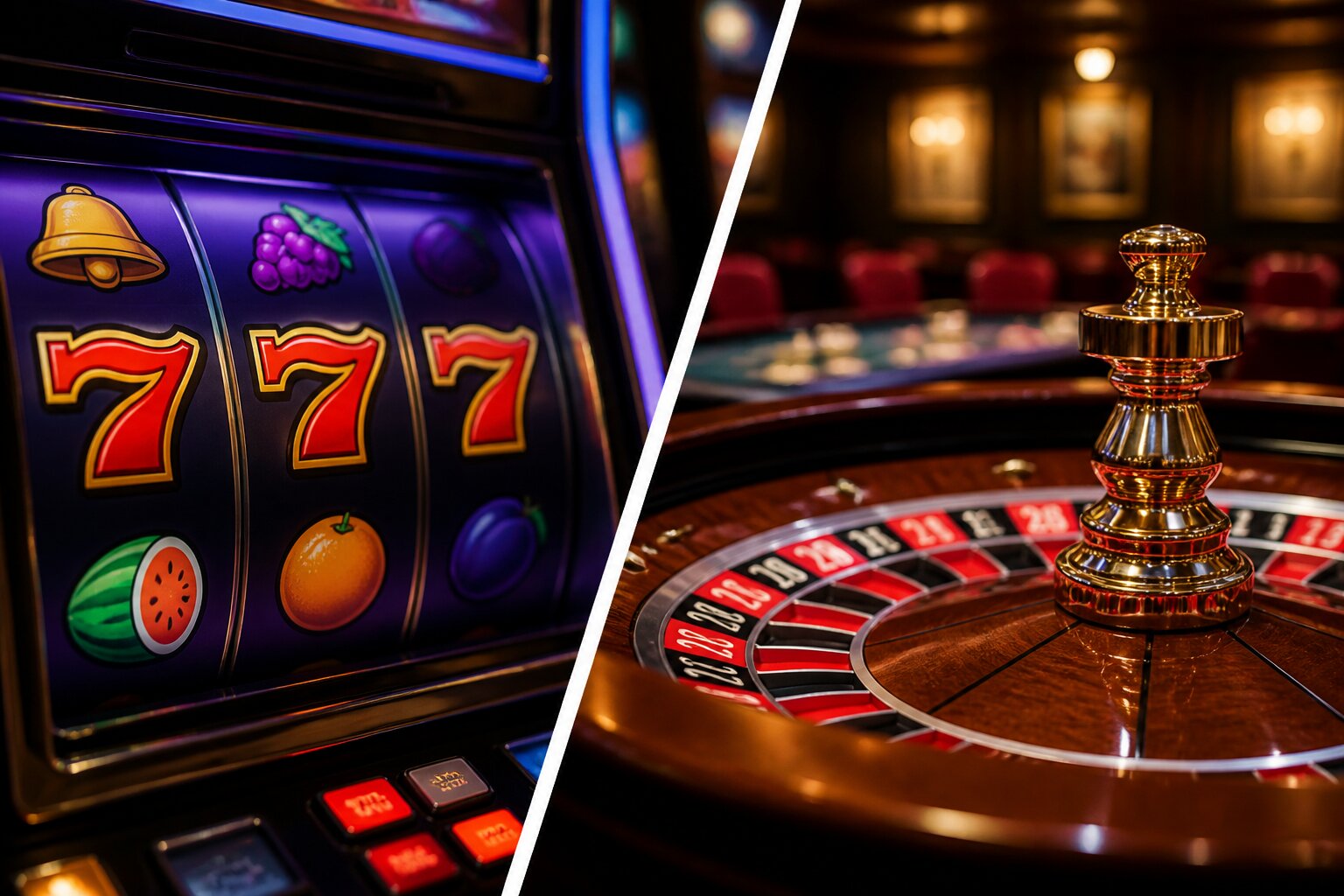
Ever found yourself torn between spinning the slots or placing a bet on the roulette wheel? It’s a choice most of us face in a casino, whether online or on the high street. Slot machines dazzle with flashing reels and rapid spins, while roulette carries an old-school appeal, the turning wheel and the slow build of anticipation as the ball settles into a pocket.
Both games are easy to pick up but offer very different experiences, not just in how you play but in how outcomes are produced and how bets are structured. Which one stretches your pounds further depends on the mechanics behind each game and the style of play you prefer.
Understanding the Basics: How Do Slot Machines and Roulette Work?
Modern online versions use digital reels covered with symbols. You set a stake, press spin, and the software selects an outcome for that spin using a random number generator. If symbols line up on a winning pattern, the game pays out according to its rules. Many slots also include bonus features such as free spins or special rounds, which change the way payouts can occur.
Roulette is a table game where players place chips on a layout to back single numbers, groups of numbers, colours, or even/odd outcomes. A dealer spins the wheel and drops a small ball; the pocket where the ball stops decides the winners. Payouts vary with the bet type, with single-number bets paying more and broader bets paying less.
It is important to treat gambling as entertainment and set limits before playing. When you are ready, the next section explores how the two games differ beneath the surface, which helps explain why results and player control feel so distinct.
What Are the Key Differences in Game Mechanics?
A fundamental difference lies in how outcomes are produced. Slots rely on computer-based random number generators that decide each spin instantly, while roulette uses a physical wheel in person or a live-streamed wheel in some online games. That contrast affects how the games feel: slots are about rapid, repeated results, whereas roulette offers a more measured rhythm and the ceremony of a single resolution.
Decision-making differs too. On slots, choices are mostly about stake size and sometimes how many paylines to cover, with the machine determining the rest. Roulette gives players a broader menu of bets, letting them spread risk across numbers, colours or thirds of the wheel. This means players can tailor risk and reward more precisely in roulette.
Volatility completes the picture. Many slots are built with varying volatility profiles: some return small, frequent wins while others pay out rarely but in bigger amounts. Roulette’s volatility is tied to the bets chosen: straight-number bets are high variance, even-money bets are low variance. Pace also separates the games, with slots offering quick successive spins and roulette pausing between rounds to allow bet placement and observation.
Understanding these mechanics leads naturally into the many variations each game offers, which can change strategy and enjoyment.
Slot Machine Variations vs Roulette Types
Both slots and roulette come in many forms, and the variation can shape how you play and what you might expect from a session.
Common Types of Slot Machines Explained
Traditional three-reel slots keep gameplay simple, typically featuring a small number of paylines and straightforward symbols. Video slots expand on that with multiple reels, dozens of paylines, animated graphics and bonus features, creating more ways to win and more layers of engagement. Progressive jackpot slots add a running top prize funded by a portion of players' bets, producing occasional very large payouts alongside infrequent wins. There are also branded or themed titles that borrow familiar images and sounds to create a recognisable backdrop for play.
American, European & French Roulette: What’s the Difference?
European roulette has 37 pockets with a single zero, which keeps the house edge relatively low. American roulette adds a double zero pocket, increasing the number of possible outcomes and raising the house edge. French roulette mirrors the single-zero layout but includes rules such as La Partage and En Prison, which can return part or all of an even-money stake when the ball lands on zero, effectively lowering the house advantage on those bets.
Knowing which version you are playing matters because those small rule differences change the mathematical expectations for each bet. The next section examines those expectations in plain terms, showing how payouts and odds compare across the two game types.
Payouts and Odds: Which Game Offers Better Value?
Slots publish a Return to Player percentage, or RTP, which represents the average share of wagers returned to players over a very large sample of spins. A typical slot RTP might sit in the mid-90s percentage-wise, which translates to a house advantage of a few percent. Volatility still matters: two slots with the same RTP can feel very different if one pays often in small amounts and the other rarely pays but offers big sums.
Roulette’s payouts are fixed by bet type. A straight-up bet on a single number pays 35 to 1, but the probability of success depends on the wheel type. On a single-zero wheel that chance is 1 in 37, while on a double-zero wheel it is slightly lower. Even-money bets such as red or black cover 18 of 37 pockets on a single-zero wheel, giving close to a 48.6% chance of success. In terms of long-run expectation, European roulette’s house edge is about 2.7 percent, French roulette can halve that edge for even-money bets when special rules apply, and American roulette’s extra pocket increases the house edge to over five percent.
Because both games are random, published RTPs and calculated house edges describe averages across millions of plays rather than promises for individual sessions. With that in mind, the following section considers how those differences play out in the player experience.
Player Experience: What Makes Each Game Unique?
Slots tend to provide a sensory-rich, fast-moving experience. Visual themes, sound effects and bonus rounds keep play lively and minimise decision-making, which appeals to players who prefer continuous action. The variety of slot designs means each title can feel like a distinct experience, from simple three-reel machines to complex video slots with interactive bonus rounds.
Roulette creates a contrasting atmosphere. The game’s slower tempo allows time for strategy, social interaction at a table, and a focused build-up to the outcome. Players can tailor their bets in many ways from round to round, which encourages different approaches and discussion among players. Live or in-person play magnifies this feeling, while online roulette often aims to capture the same presence through streaming and a dealer.
Both formats offer strong entertainment value, but the kind of engagement differs. Pick based on whether you prefer ongoing sensory stimulation or a more deliberate, social table environment. Next, the practical impact of those preferences can be seen in the house edge calculations that follow.
House Edge Comparison: How Does It Affect Your Chances?
The house edge is the statistical advantage the operator holds over players, expressed as a percentage. It represents the expected portion of wagers retained by the house over long periods. For slots, the house edge derives from the RTP figure. If a slot has an RTP of 96 percent, the house edge is 4 percent. Typical slot house edges in the market often fall in a few percentage points range, though exact values vary by title.
European roulette’s single-zero wheel produces a house edge of 2.7 percent across most bets, while French roulette can reduce the effective edge on even-money bets to around 1.35 percent when special rules apply. American roulette, with its additional double zero, raises the house edge to approximately 5.26 percent. These figures describe long-term expectations and smooth out the short-term swings every player experiences.
For example, if £100 is wagered repeatedly on European roulette, the statistical expectation over many plays is a roughly £2.70 loss to the house. Betting the same amount on a slot with a 96 percent RTP suggests a £4 expected loss over a comparable long run. These numbers help compare theoretical value but do not predict any single session. Ultimately, the choice between slots and roulette depends on the type of play desired, tolerance for variance, and which mechanics feel more engaging for you.
Enjoy Casino Games at Clover Casino
We’d love to welcome you to enjoy our selection of casino games, all brought together for your entertainment. Whether you are new to us or have visited before, you’ll find a friendly atmosphere waiting.
Getting set up is straightforward: just create your account, make a deposit and you’re ready to explore what we have to offer. We look forward to seeing you at Clover Casino.
**The information provided in this blog is intended for educational purposes and should not be construed as betting advice or a guarantee of success. Always gamble responsibly.