
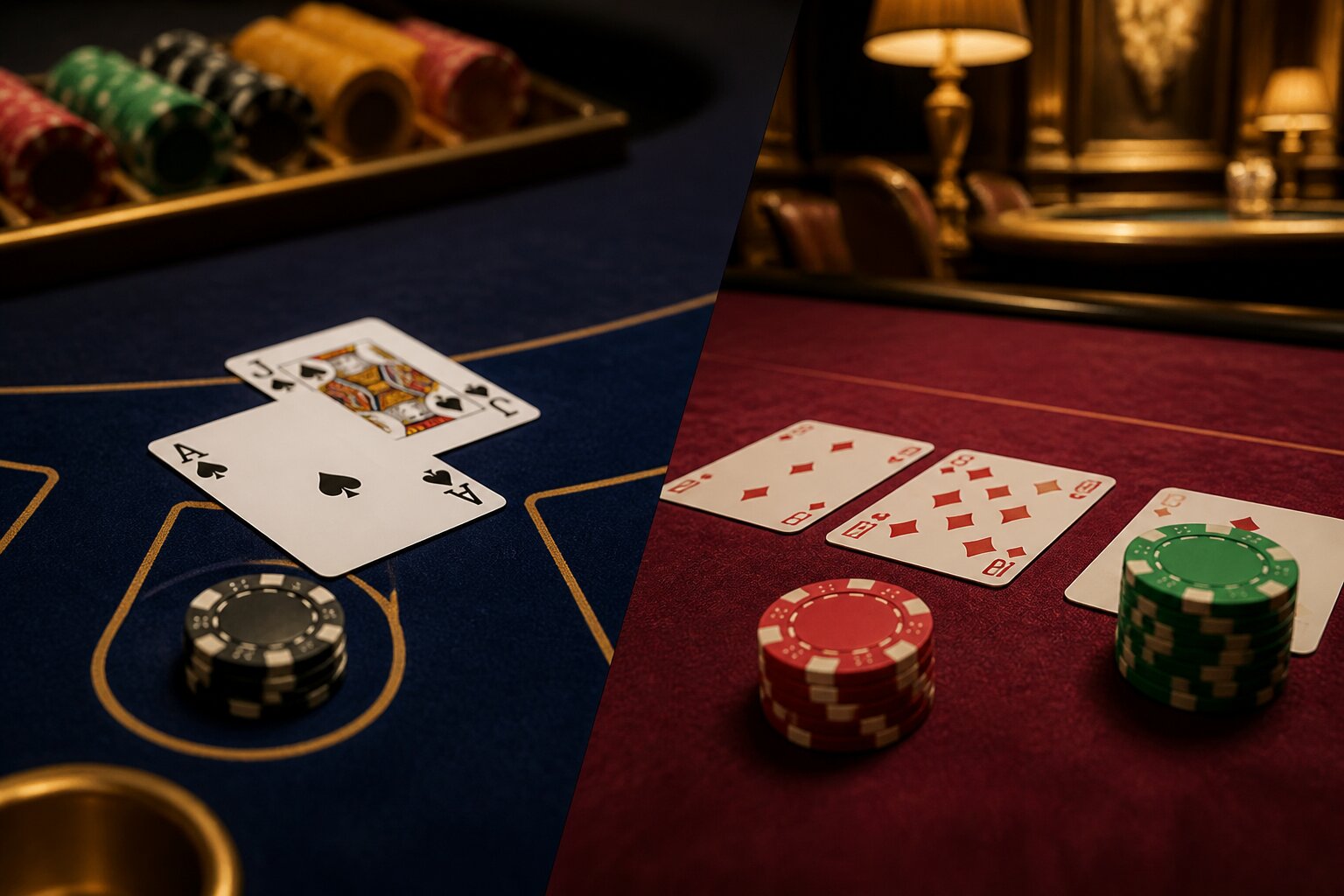
You sit at the casino table, card in hand, heart pounding, and wonder: should you stick with the familiar tension of blackjack or give baccarat a go? Both games have an air of sophistication and a loyal following, but when it comes down to the real crux—your chances of winning and how much you can walk away with—they're surprisingly different.
Whether you’re new to table games or a regular searching for a smarter way to play, knowing which game offers the better edge is key to making your money last longer and seeing clearer returns. Read on to compare how each game works, how the house edge and payouts differ, and which might suit you best.
Understanding the Basics: How Are Blackjack and Baccarat Played?
Blackjack is one of the most recognisable card games in casinos. The main goal is to beat the dealer by getting a hand as close to 21 as possible without going over. Each player and the dealer receive two cards, with one of the dealer’s cards usually visible. Players choose whether to hit for another card or stand with their current total. Picture cards count as 10, aces can be 1 or 11, and other cards use their face value. If a player’s total exceeds 21, that hand loses. Simple examples—like being dealt a 10 and a 6, then drawing a 5 to reach 21—illustrate how decisions change the outcome.
Baccarat moves in a different rhythm. You place a wager on one of three outcomes: the player hand wins, the banker hand wins, or it’s a tie. Two cards are dealt to both player and banker and only the final digit of the combined card total counts—so a 7 and 6 make 13, but the hand value is 3. Tens and face cards count as zero, aces as one. A third card may be drawn automatically according to fixed rules, but once bets are placed there are no further choices to make. This low-decision format keeps rounds swift and predictable.
Both games let you control your stake, but they differ in how much active decision-making is required during a hand. Next, we’ll explore how the casino’s mathematical advantage is measured and what that means for your chances.
House Edge Explained: What Are the Odds for Players?
The phrase “house edge” describes the casino’s long-term mathematical advantage over players, expressed as a percentage. It indicates how much, on average, the house expects to keep from each bet across many plays. For instance, a 1% house edge implies the house expects to keep £1 from every £100 wagered over time. This percentage doesn’t predict individual sessions but is useful for comparing games and bets.
What Is the House Edge in Blackjack?
Blackjack is known for offering one of the lowest house edges available at a casino—provided basic strategy is used. Following the best strategic decisions for hitting, standing, doubling or splitting typically brings the house edge down to around 0.5% in common multi-deck games. In practical terms, that means the expected loss on large volumes of play is relatively small compared with many other casino options. Departing from basic strategy, however, raises the house edge and makes results less favourable over time.
What Is the House Edge in Baccarat?
Baccarat’s house edge varies by the bet you choose:
- Banker: around 1.06% house edge, generally the best option in the game.
- Player: about 1.24% house edge, slightly worse than banker but still low.
- Tie: far higher house edge, typically around 14%, making it the riskiest choice.
These percentages show that both blackjack (when played with sound strategy) and the banker/player bets in baccarat rank among the casino’s more favourable options. With that in mind, the next section looks at how those theoretical advantages translate into the actual sums returned when you win.
Comparing Typical Payouts in Both Games
Payouts determine what you collect after a winning bet and help illustrate how the house edge affects returns. In blackjack, a standard win pays even money: a £10 win yields £10 profit and £20 returned overall. A natural blackjack—an ace plus a ten-value card on the first two cards—typically pays 3:2, so a £10 stake returns £25 in total (£15 profit). Some tables offer 6:5 for a natural, which reduces the payout to £12 profit on a £10 stake; this change noticeably increases the house advantage, so checking table rules matters.
Baccarat’s common payouts are straightforward. Player and banker bets normally pay even money, but winning banker bets are usually subject to commission (commonly 5%), lowering the net return to about £9.50 profit on a £10 win. Tie bets pay substantially more—often 8:1—but come with a much worse expected return, reflecting the high house edge described earlier.
Both games reward sensible choices: larger or rarer payouts come with longer odds and a bigger built-in advantage for the house. With that in mind, rule variations and extra wagers can further alter outcomes, which is what we’ll examine next.
Dealing with Variants: How Do Rule Differences Impact Outcomes?
Rule variations and optional wagers change the math behind both blackjack and baccarat. Small changes—such as the number of decks in blackjack, different payout ratios for naturals, or added side bets—can nudge the house edge up or down and alter how frequently particular results occur.
Do Side Bets Affect Your Potential Wins?
Side bets offer tempting payouts for uncommon combinations, but their expected returns are usually poorer than main bets. In blackjack, options like Perfect Pairs or 21+3 can show attractive top-line payouts (25:1, for example), yet they often carry house edges above 5–7%. In baccarat, pair bets or specially labelled propositions might pay handsomely but commonly have house edges that exceed single-digit percentages. These wagers can be entertaining, but they typically reduce your long-term expected return compared with sticking to standard bets.
How Does the Number of Decks Matter?
The number of decks is another influential factor, particularly in blackjack. Fewer decks can slightly lower the house edge because certain favourable card combinations, including naturals, occur more often. Most modern casino blackjack uses multiple decks, which slightly increases the house advantage compared with single-deck games. In baccarat, deck count has a subtler effect but generally follows the same direction: more decks tend to nudge the house edge up a little.
Understanding these variant effects helps when choosing a table or game rule set, so you can favour options that offer the best mathematical return. Up next, we’ll consider how approachable each game is for someone learning the ropes.
Which Game Is Easier for Beginners?
Baccarat is usually the simpler start for newcomers. Betting is limited to selecting player, banker or tie and the rest of the round follows automatic rules, so there’s no need to learn a range of in-play decisions. That clarity makes baccarat easy to follow during a busy session.
Blackjack involves more choices and a steeper initial learning curve. Deciding whether to hit, stand, double or split affects each hand, and those decisions matter to your expected result. Many players use basic strategy charts to remove guesswork and keep the house edge low, which turns blackjack into a more skill-influenced game over time.
Which is easier depends on personal preference: pick baccarat for simple, fast rounds with low decision-making, or blackjack if you enjoy weighing choices and managing each hand. Either way, understanding the rules and the odds helps make informed decisions at the table.
Play in a way that suits your temperament and bankroll, and choose the game whose pace and choices you find most enjoyable.
Play Casino Games Online at Clover Casino
We would love to welcome you into our friendly community of players, all enjoying the variety of casino games on offer at Clover Casino. With us, you can enjoy the thrill of gaming alongside others who share your passion for entertainment.
Getting started is simple: just create an account, make a deposit and you are ready to explore our site. We look forward to seeing you join our community and enjoy everything we have to offer.
**The information provided in this blog is intended for educational purposes and should not be construed as betting advice or a guarantee of success. Always gamble responsibly.